
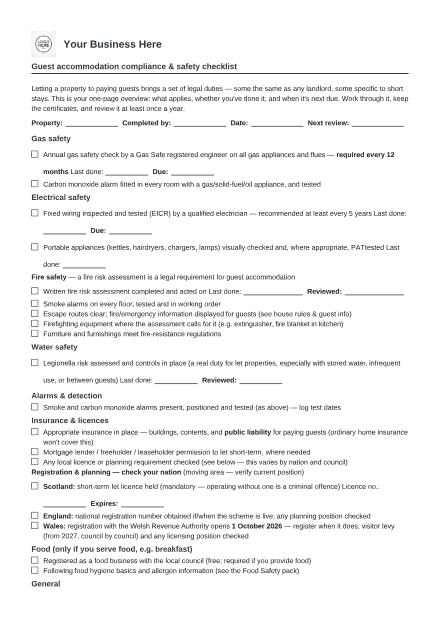
Guest accommodation compliance & safety checklist
Gas, electric, fire, legionella, licensing — every duty of letting to paying guests.
£14 inc. VAT — yours forever, no subscription.Or get it in the Guest Accommodation pack — £29.
Type your business name and the preview updates in seconds — the real PDF, editable on screen or printable to fill in by pen. Nothing about your business leaves your browser.
What you need to know
The plain-English guidance that comes with this document.
- Letting to paying guests is not the same as living in your home. The moment money changes hands for a stay, a stack of safety duties switches on: gas, electrical, fire and water safety all apply, and some are criminal offences to ignore. This checklist is your map of them. It doesn't replace the individual records (gas certificate, fire risk assessment, legionella assessment) — it points you to each one.
- Gas: annual, non-negotiable. If there's any gas appliance, you need an annual Gas Safety check by a Gas Safe registered engineer and must keep the record. This is the same duty a landlord has, and it's the one most likely to be checked after an incident.
- Fire risk assessment is a legal requirement here — this is the big one. Guest accommodation counts as premises where fire safety law applies, so you must have a written fire risk assessment, act on it, and keep it reviewed. Smoke alarms, clear escape routes, and clear fire information for guests all flow from it. Don't skip it because the place "feels safe" — the assessment is the legal evidence.
- Legionella is a real and commonly-missed duty. Let properties — especially ones that sit empty between guests, or have stored hot/cold water, showers or a hot tub — carry a legionella risk that you're expected to assess and control. For most simple properties it's a straightforward assessment and simple measures (flushing outlets between lets, keeping hot water hot). A hot tub raises the stakes considerably.
- Ordinary home insurance won't cover paying guests — you need the right policy, including public liability. If a guest is hurt and you're not properly insured, you're exposed personally. Tell your insurer exactly what you're doing, and check any mortgage or leasehold conditions on short-term letting too.
- Licensing and registration is the fast-moving piece — check your nation before you rely on this. As at mid-2026: Scotland has had mandatory short-term let licensing since 2023 — operating without a licence is a criminal offence. England's national registration scheme has been confirmed in principle but is not yet live, and a planning "use class" for short-term lets has been consulted on but not implemented — so check the current position before assuming either applies. Wales has legislated for registration with the Welsh Revenue Authority — the register opens 1 October 2026, with a visitor levy possible from 2027 where a council adopts it — and has its own planning classes, with a licensing scheme planned for later. Because this genuinely changes, treat the boxes above as prompts to verify, not settled facts.
- Serving breakfast? You're a food business. Even a simple B&B breakfast means you must register (free) with your council as a food business and follow basic food hygiene and allergen rules. Our Food Safety pack covers the day-to-day side.
- Review it yearly and after any change. New hot tub, new heating, a bad review about a cold room, a change in the law — reassess. Date it, keep the certificates together, and you'll be ready if anyone ever asks.
- This is a professionally structured starting point — confirm the specifics for your property and nation. It's a strong overview, not a guarantee that you've covered everything for your exact setup. A visit from a competent person (gas engineer, electrician, fire assessor) is what turns the ticks into evidence.
Please note: This is a template for guidance only. Adapt it to your business and check it against current law and your insurance requirements. It is not legal advice.