
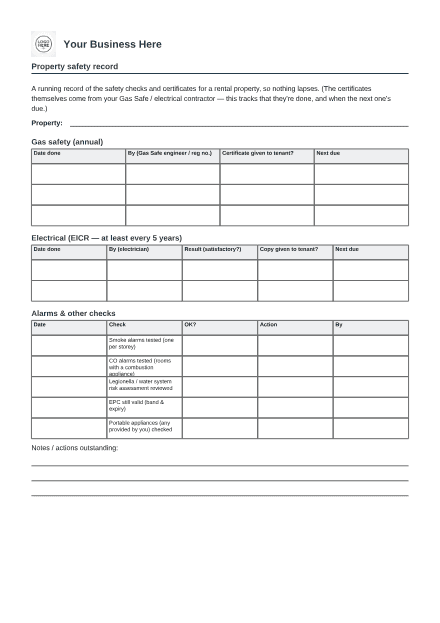
Property safety record
Gas, EICR, alarms and legionella in one log — so nothing lapses.
£7 inc. VAT — yours forever, no subscription.Or get it in the Landlord & Lettings pack — £34.
Type your business name and the preview updates in seconds — the real PDF, editable on screen or printable to fill in by pen. Nothing about your business leaves your browser.
What you need to know
The plain-English guidance that comes with this document.
- Lapsed safety certificates are the landlord trap. A gas certificate that expired last month, or an EICR that's silently gone past five years, can mean fines, invalid insurance, and — importantly — losing the ability to regain possession. This log keeps every renewal date in one place so nothing slips.
- Gas: every year, by a Gas Safe engineer, and hand it over. An annual gas safety check on all gas appliances and flues is a legal must, and you must give the tenant the record (within 28 days, and to new tenants at the start). Only a Gas Safe registered engineer can do it — check the register.
- Electrics: an EICR at least every five years — and act on the findings. The Electrical Safety Standards require a satisfactory inspection at least every five years, a copy to the tenant, and any "C1/C2" faults fixed within 28 days. Don't file an EICR that says "unsatisfactory" and do nothing.
- Alarms: test at the start of every tenancy. At least one smoke alarm on each storey, and a CO alarm in any room with a fixed combustion appliance (boiler, wood burner — not gas cookers), all working at the start of the tenancy. Test and record it.
- Legionella is a real, if small, duty. Landlords should assess and manage the risk of legionella in the water system — usually simple for a normal home, but you're expected to have thought about it.
- This tracks the checks; keep the actual certificates too. File the gas record, EICR and EPC themselves alongside this log, and keep proof you gave copies to the tenant.
- England-led; check your nation. Gas and electrical safety duties apply across GB with local variation; Wales, Scotland and Northern Ireland have their own wider letting rules. Confirm the specifics where your property is.
Please note: This is a template for guidance only. Adapt it to your business and check it against current law and your insurance requirements. It is not legal advice.