
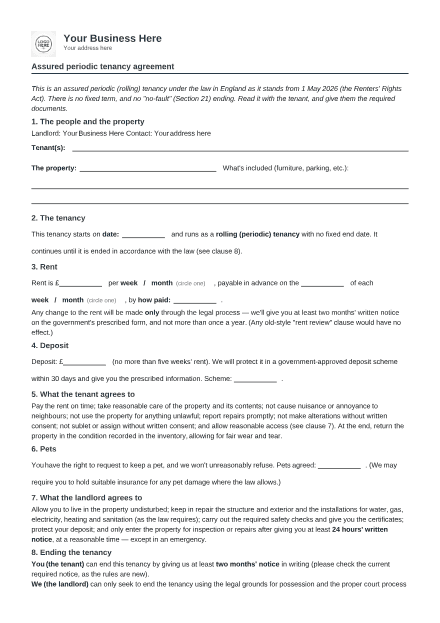
Assured periodic tenancy agreement
The post-2026 rolling tenancy — no fixed term, no S21. England only.
£14 inc. VAT — yours forever, no subscription.Or get it in the Landlord & Lettings pack — £34.
Type your business name and the preview updates in seconds — the real PDF, editable on screen or printable to fill in by pen. Nothing about your business leaves your browser.
What you need to know
The plain-English guidance that comes with this document.
- This reflects a brand-new legal regime — get it checked before you rely on it. The Renters' Rights Act reshaped tenancies in England from 1 May 2026, and this agreement is written to that new world (periodic tenancy, no fixed term, no Section 21, statutory rent increases). Because the law is so new and a tenancy is a binding contract, have this reviewed by a solicitor or a landlord association (like the NRLA) and use the current prescribed forms. It's a professionally structured starting point — not "compliant out of the box".
- There's no more fixed term, and no more Section 21. Don't add a "12-month fixed term" or a "no-fault" ending — both are gone. The tenancy simply rolls until ended lawfully. If you need possession, it's via the statutory grounds (Section 8) and the court — which is genuinely legal-advice territory. Don't improvise a notice.
- Rent increases have a set procedure now. You can't rely on a rent-review clause (they're void). You must serve the correct government notice, giving at least two months, no more than once a year. Use the current prescribed form.
- Serve the documents, and protect the deposit — or you'll regret it. The tenancy isn't the end of it: you must give the tenant the gas certificate, EICR, EPC and How to Rent guide, protect the deposit within 30 days and serve the prescribed information. Failing to do these can block a future possession claim and lead to penalties. Your compliance checklist covers the full list.
- Pets: you can't just say no. Tenants have a right to request a pet and you can only refuse with a good reason. Consider it properly and respond — a blanket "no pets" clause won't hold.
- This is England only — the other nations are completely different. Wales uses "occupation contracts" under the Renting Homes (Wales) Act; Scotland uses Private Residential Tenancies; Northern Ireland has its own system. Do not use this agreement outside England — use that nation's correct tenancy type.
- When in real doubt, don't DIY the contract. For anything unusual (an HMO, a company let, a lodger, shared ownership, possession action), get proper advice. A good agreement checked once is far cheaper than a possession claim that fails on a technicality.
Please note: This is a template for guidance only. Adapt it to your business and check it against current law and your insurance requirements. It is not legal advice.