
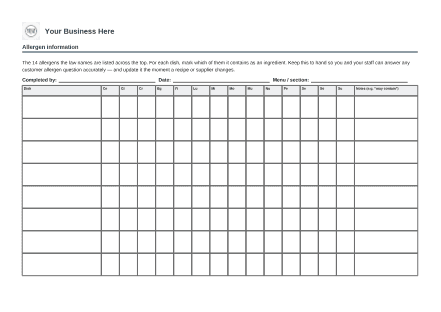
Allergen matrix
Your dishes against the 14 named allergens — the accurate answer, every time.
£7 inc. VAT — yours forever, no subscription.Or get it in the Food Safety pack — £29.
Type your business name and the preview updates in seconds — the real PDF, editable on screen or printable to fill in by pen. Nothing about your business leaves your browser.
What you need to know
The plain-English guidance that comes with this document.
- These are the 14 allergens the law names — no more, no less. Celery, cereals containing gluten (wheat, rye, barley, oats), crustaceans, eggs, fish, lupin, milk, molluscs, mustard, tree nuts, peanuts, sesame, soya, and sulphur dioxide/sulphites. Every food business has to be able to tell a customer which of these is in a dish. This matrix is how you do it accurately, every time, without relying on memory.
- In writing, backed by a conversation — that's what's expected. For food you serve loose (not pre-packed), the FSA's clear advice is that allergen information should be available in writing and backed up by talking it through with the customer. A written matrix like this, plus staff who know to have the conversation, is the safe way to meet your duty. Never guess, and never say "it should be fine."
- Prepacked for direct sale? Natasha's Law means a full label. If you make food and pack it before a customer orders it — sandwiches in a chiller, cakes wrapped for the counter — it's "prepacked for direct sale" and must carry a full ingredients list with the 14 allergens emphasised (usually in bold). This matrix supports it, but the packaged item itself needs the label.
- Cross-contamination is the killer — be honest about it. The matrix records allergens that are ingredients. But if you fry different foods in the same oil, or prep on shared boards, traces can carry over. Use the notes column for genuine "may contain" risks — but only where the risk is real, and back it with actually managing your kitchen, not a blanket disclaimer that customers learn to ignore.
- It's only as good as its last update. A changed recipe, a new supplier, a "temporary" substitution — any of these can change the allergens in a dish. Update the matrix the moment anything changes, and check ingredient information from your suppliers rather than assuming. Date it so everyone knows it's current.
- Train everyone, including the Saturday help. The best matrix in the world fails if the person on the till doesn't know it exists or how to use it. Show every food handler where it is, how to read it, and that the answer to "is there anything you're allergic to?" is a real conversation, not a shrug.
- Applies UK-wide, with local schemes. Allergen law applies across the UK. Your food hygiene rating (the Food Hygiene Rating Scheme in England, Wales and Northern Ireland; the Food Hygiene Information Scheme in Scotland) will reflect how well you manage this — and Wales and Northern Ireland require you to display the rating.
Please note: This is a template for guidance only. Adapt it to your business and check it against current law and your insurance requirements. It is not legal advice.