
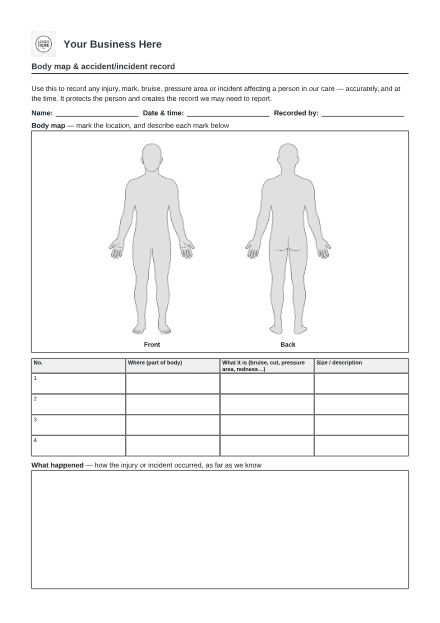
Body map & accident/incident record
Body map plus accident/incident record, with notifiable-event prompts.
£7 inc. VAT — yours forever, no subscription.Or get it in the Care Services pack — £49.
Type your business name and the preview updates in seconds — the real PDF, editable on screen or printable to fill in by pen. Nothing about your business leaves your browser.
What you need to know
The plain-English guidance that comes with this document.
- Record injuries at the time, and accurately — it protects everyone. A body map removes ambiguity about where and what. An unexplained bruise or a pressure sore recorded properly protects the person (it gets acted on) and the service (it shows you noticed and responded). Vague or late records do the opposite.
- An unexplained injury is a safeguarding question until proven otherwise. Marks with no clear cause — especially bruising in unusual places, or a sudden deterioration in skin — must make you think safeguarding and consider a referral. Don't explain it away; record it, report it, and let the process decide.
- Pressure sores are a red flag. A developing pressure ulcer can indicate care that's fallen short and is often reportable. Record skin changes early, act on them (repositioning, equipment, district nurse), and escalate.
- Know what has to be reported — and to whom. Serious injuries, certain incidents and deaths can be notifiable events to your regulator (the CQC has a list of statutory notifications), and some injuries at work are RIDDOR-reportable. Build the habit of asking "does this need reporting?" every time.
- Tell the person and their family. Openness (the duty of candour, for CQC-registered providers) means being honest with the person and those close to them when something goes wrong. Record that you did.
- Special-category data — lock it down. Injury and health records are highly sensitive. Store securely, share only as needed.
- Professionally structured starting point — adapt and sign off. A registered manager sets how incidents are recorded, escalated and reported in your service; it's not "compliant out of the box".
- Applies UK-wide, with different notification rules. Notifiable-events and safeguarding routes differ across the CQC (England), CIW (Wales), Care Inspectorate (Scotland) and RQIA (NI). Check your regulator's requirements.
Please note: This is a template for guidance only. Adapt it to your business and check it against current law and your insurance requirements. It is not legal advice.