
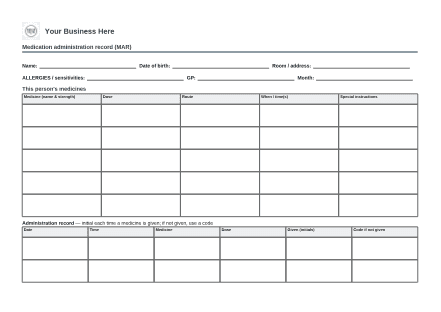
Medication administration record (MAR)
The MAR — allergies up top, the rights of administration, codes.
£14 inc. VAT — yours forever, no subscription.Or get it in the Care Services pack — £49.
Type your business name and the preview updates in seconds — the real PDF, editable on screen or printable to fill in by pen. Nothing about your business leaves your browser.
What you need to know
The plain-English guidance that comes with this document.
- Medication is where care goes badly wrong fastest — treat this record accordingly. A MAR is a legal and clinical record. Errors — missed doses, wrong person, wrong dose — cause real harm and are a leading cause of safeguarding referrals and inspection failures. Fill it in at the point of giving the medicine, never in advance and never "catching up later".
- The rights of administration, every time. Right person, right medicine, right dose, right route, right time — and the right to refuse and to have it recorded. Check them all before you give anything, and record it straight away.
- Allergies in capitals, up top. The allergies line exists to stop a fatal mistake. Make it impossible to miss, and check it against every medicine.
- Never leave medicines out, and never "pre-pot". Don't leave tablets by the bedside or set them out in advance for someone else to give — that breaks the chain of who gave what, and it's a classic error and safeguarding risk. The person who gives it records it.
- Covert medication is a serious step — MCA first. Hiding medicine in food is only ever lawful for someone who lacks capacity for that decision, as a best-interests decision made with the GP and pharmacist and a clear plan. Never do it to a person who has capacity, and never informally. Use your mental capacity record.
- PRN needs a protocol. "When required" medicines need clear guidance on when and how much, especially for people who can't ask. Record what you gave, why, and whether it worked — not just an initial.
- Codes, counts and disposal. Use the code key for anything not given and note why. Keep track of stock (booking in and returns), and return or dispose of medicines properly through the pharmacy. Follow NICE guidance on managing medicines in care.
- Professionally structured starting point — tailor and sign off. A registered manager should adapt this to your setting (many residential homes use a printed monthly grid chart) and to safe-handling training; it's not "compliant out of the box".
- Applies UK-wide. Safe medicines management is expected by the CQC (England), Care Inspectorate Wales, the Care Inspectorate (Scotland) and RQIA (NI), all drawing on NICE/professional guidance. Staff giving medicines must be trained and competence-checked.
Please note: This is a template for guidance only. Adapt it to your business and check it against current law and your insurance requirements. It is not legal advice.