
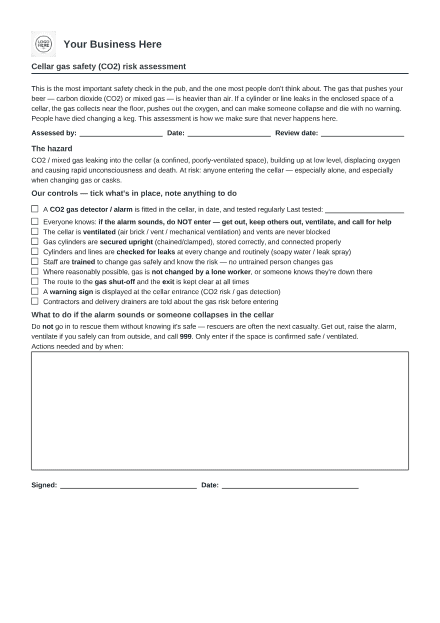
Cellar gas safety (CO₂) risk assessment
The life-safety one — the gas that pushes your beer can kill in a cellar.
£14 inc. VAT — yours forever, no subscription.Or get it in the Pub & Bar pack — £34.
Type your business name and the preview updates in seconds — the real PDF, editable on screen or printable to fill in by pen. Nothing about your business leaves your browser.
What you need to know
The plain-English guidance that comes with this document.
- This is a genuine killer, and it's badly under-appreciated. Cellar gas incidents are rare but they are catastrophic and they keep happening — a leaking CO₂ line or cylinder in an enclosed cellar can render someone unconscious in moments and dead soon after, with no smell or warning. If you take one safety document in this pack seriously, make it this one.
- CO₂ is heavier than air — that's what makes a cellar lethal. The gas sinks and pools at floor level exactly where someone works, changing a keg or crouching at the cylinders. A cellar is effectively a confined space. Ventilation and gas detection are the controls that keep it safe; without them you're relying on luck.
- A cellar gas alarm is essential, not optional. A fixed CO₂ detector with an audible/visual alarm is the single most important control — it warns before levels become dangerous. Keep it in date, test it, and make sure every member of staff knows the golden rule: if it sounds, do not go in. Many pubs are required to have one and all should.
- Never rescue without making it safe — the rescuer becomes the second victim. The instinct to rush in and pull someone out is exactly how single cellar deaths become double ones. Get out, ventilate from outside if you can, and call 999. Only a properly-equipped responder should enter an unsafe space.
- Secure the cylinders and check for leaks. Gas cylinders must be upright and secured so they can't fall, connected correctly, and leak-checked at every change and routinely in between (a smear of soapy water shows bubbles at a leak). This is the maintenance half of the risk; the detection and ventilation are the safety-net half.
- Train everyone who goes near the gas, and think hard about lone working. Only trained staff should change gas, and changing it — or working in the cellar at all — alone is higher risk because there's no one to raise the alarm. Where you can, make sure someone knows a person is in the cellar. Pair this with your Safety pack's lone-working assessment.
- This is a professionally structured starting point — get a competent person to check your cellar. Every cellar is different (size, ventilation, dispense). A cellar-services engineer or gas specialist should confirm your detection, ventilation and set-up are adequate. Review this assessment yearly and after any change to the cellar or dispense system.
Please note: This is a template for guidance only. Adapt it to your business and check it against current law and your insurance requirements. It is not legal advice.