
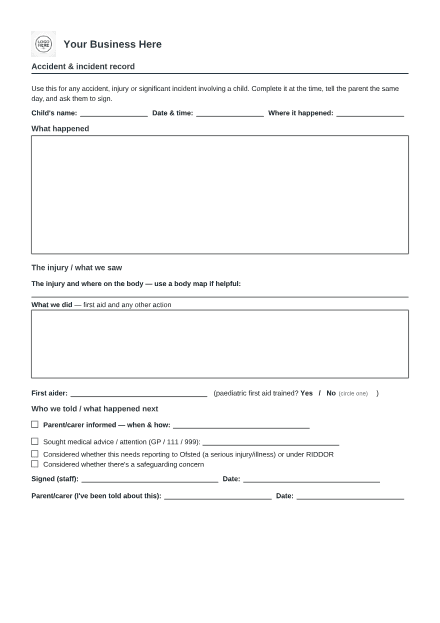
Accident & incident record
Recorded at the time, told to the parent the same day, signed.
£7 inc. VAT — yours forever, no subscription.Or get it in the Childcare & Early Years pack — £39.
Type your business name and the preview updates in seconds — the real PDF, editable on screen or printable to fill in by pen. Nothing about your business leaves your browser.
What you need to know
The plain-English guidance that comes with this document.
- Record it at the time, and tell the parent the same day. The EYFS requires you to keep a record of accidents and injuries and to inform parents. A note written at the time and shown to the parent (with their signature) is both good care and your evidence you handled it properly.
- Know what has to be reported to Ofsted — and RIDDOR. Certain serious accidents, injuries, illnesses or a child's death must be notified to Ofsted (usually within 14 days), and some are RIDDOR-reportable. Build the habit of asking "does this need reporting?" every time — the answer's usually no, but the times it's yes really matter.
- Watch for the safeguarding angle — and note the lower bar from September 2026. An injury that doesn't quite add up, or a pattern of accidents, should make you think — and possibly link to your pre-existing injury records and safeguarding policy. Record facts, not assumptions. From 1 September 2026 the EYFS requires you to report any allegation of harm or abuse to Ofsted (the word "serious" has been removed from that threshold), so if an accident raises a safeguarding concern, follow your safeguarding policy and err on the side of reporting.
- Only paediatric-first-aid-trained staff should give first aid to children. The EYFS requires PFA-trained staff on site (and childminders to hold it). Note who gave the first aid and that they're trained.
- Spot patterns and prevent the next one. A run of the same accident in the same spot is your risk assessment telling you something. Feed incidents back into your risk assessments and change the environment.
- It's sensitive data — store it securely. Keep it confidential, share only with those who need it, and keep each child's records safe.
- Professionally structured starting point — adapt and sign off. A manager tailors reporting thresholds and routes to your setting and regulator; it's not "compliant out of the box". England-led — Wales/Scotland/NI have their own regulators and notification rules.
Please note: This is a template for guidance only. Adapt it to your business and check it against current law and your insurance requirements. It is not legal advice.