
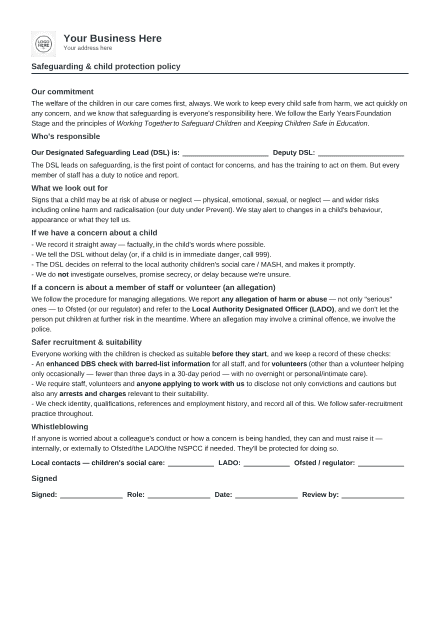
Safeguarding & child protection policy
The one Ofsted cares about most — DSL, referral routes, LADO, whistleblowing.
£14 inc. VAT — yours forever, no subscription.Or get it in the Childcare & Early Years pack — £39.
Type your business name and the preview updates in seconds — the real PDF, editable on screen or printable to fill in by pen. Nothing about your business leaves your browser.
What you need to know
The plain-English guidance that comes with this document.
- Updated for the EYFS framework in force from 1 September 2026. This version reflects the September 2026 changes to the safeguarding and welfare requirements: you must now report any allegation of harm or abuse to Ofsted (the word "serious" has been removed from the threshold); DBS/barred-list checks are required for volunteers (bar the very occasional helper); and staff and prospective staff must disclose arrests and charges, not just convictions and cautions. If you're reading this before September 2026, adopt the new wording now so you're ready — the direction of travel only tightens.
- Safeguarding is the heart of early-years compliance — get this one exactly right. It's the thing Ofsted (and every parent) cares about most, and the EYFS requires a written safeguarding policy and a trained Designated Safeguarding Lead. This is a starting point a competent DSL must tailor to your setting and your local safeguarding partnership's procedures, and have checked — it is not "compliant out of the box".
- Everyone reports; the DSL decides and refers. The single most important rule: any concern goes to the DSL straight away, and the DSL makes the referral. Staff don't investigate, don't promise secrecy, and don't wait until they're sure. If a child is in immediate danger, it's 999.
- Allegations against staff or volunteers go a different route — the LADO — and the bar is now "any" harm. A concern about an adult who works with the children is handled through the Local Authority Designated Officer and reported to Ofsted. From September 2026 that duty is triggered by any allegation of harm or abuse, not just serious ones — so err on the side of reporting. Don't deal with it "in-house" and hope.
- Suitability checks are non-negotiable, now reach volunteers, and cover arrests and charges. Enhanced DBS with barred-list checks before anyone works with the children — including volunteers other than the very occasional helper — kept on a record, and a disclosure duty that now extends to arrests and charges and to people applying to join you. Safer recruitment isn't a formality; it's a core protection, and it just got broader.
- Record factually, and fast. Write what you saw or were told, in the child's words where you can, at the time. These records can become evidence.
- Keep it live: DSL trained, staff trained, contacts current. A safeguarding policy is only as good as the training behind it and the local contacts in it. Keep the DSL and staff training up to date, brief everyone on the September 2026 changes, and check the phone numbers work.
- England-led; different bodies elsewhere. England follows the EYFS, Working Together to Safeguard Children, Keeping Children Safe in Education and local safeguarding partnerships (Ofsted; LADO). Wales, Scotland and Northern Ireland have their own safeguarding frameworks and regulators — use yours.
Please note: This is a template for guidance only. Adapt it to your business and check it against current law and your insurance requirements. It is not legal advice.