Childcare risk assessment
Premises, activities and outings — managing risk, not removing all of it.
£7 inc. VAT — yours forever, no subscription.Or get it in the Childcare & Early Years pack — £39.
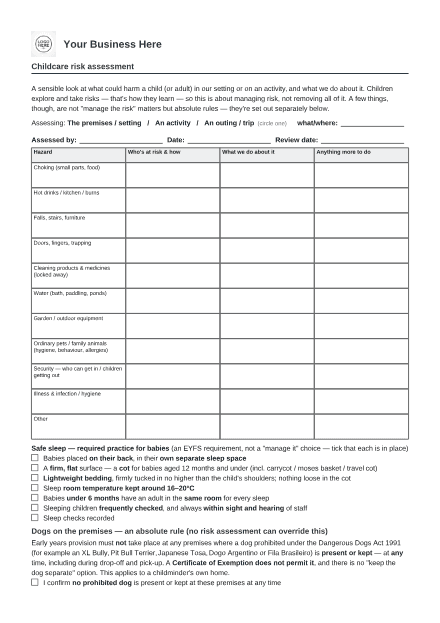
Type your business name and the preview updates in seconds — the real PDF, editable on screen or printable to fill in by pen. Nothing about your business leaves your browser.
What you need to know
The plain-English guidance that comes with this document.
- Updated for the EYFS framework in force from 1 September 2026. Three September 2026 changes are built in below — but note that two of them are not ordinary "assess and control" hazards. Safe sleep is a set of specific required practices, and banned dog breeds are an outright prohibition. That's why they sit outside the hazard grid: putting "banned dog" in a grid with a "what we do about it" column invites exactly the wrong answer.
- Banned dog breeds: an absolute bar, and the exemption route has closed. From September 2026 you cannot deliver early years provision from premises where a dog banned under the Dangerous Dogs Act 1991 is present or kept — at any time, including drop-off and pick-up. Crucially, a Certificate of Exemption no longer makes it acceptable (the previous "keep it certified and separate" approach was judged too risky). This bites hardest on home-based childminders, whose own family pet is in scope. There is nothing to "mitigate" here — the dog cannot be there. If this affects you, speak to Ofsted before continuing. (Nannies working in the child's own home are outside this rule.)
- Safe sleep is now statutory and specific — meet every element. For babies the framework now requires: on the back, in their own sleep space, on a firm flat surface (a cot for those 12 months and under), lightweight bedding tucked in below the shoulders, a room kept around 16–20°C, an adult in the room for under-sixes' every sleep, and frequent checks with children always in sight and hearing. Record your sleep checks. These aren't suggestions — they're the requirement, and unsafe sleep is one of the highest-stakes risks in the whole setting.
- Screen use — have a considered, defensible position. "Must have regard to" means you take the DfE guidance into account and normally follow it unless you have a sound reason not to. In practice: avoid screens for under-2s (bar the occasional video call with a parent), keep 2–5s to purposeful use of up to about an hour a day, and stay alongside the child. Write down your approach so you can show you've thought it through.
- Ordinary pets are still a normal, manageable hazard. A family dog, cat or rabbit that isn't a banned breed is a legitimate risk-assessment item — hygiene, temperament, allergies, keeping animals away from food and sleep areas. That belongs in the grid; the banned-breed prohibition does not.
- Risk assessment is an EYFS requirement — and just good sense with small children. A written assessment, acted on and reviewed, is your evidence you've thought it through — and Ofsted will look for it. Manage the serious risks (choking, water, hot things, escaping, unsafe sleep) while still letting children have real experiences.
- Outings need their own assessment, every time — ratios (often higher), headcounts at every transition, first aid kit, emergency contacts, and a plan for a lost child.
- Review after any incident or change, and feed your accident records back in.
- Professionally structured starting point — adapt and sign off. A manager/childminder tailors this to the actual premises and ages; it's not "compliant out of the box". England-led (EYFS); other nations have their own frameworks.
Please note: This is a template for guidance only. Adapt it to your business and check it against current law and your insurance requirements. It is not legal advice.