
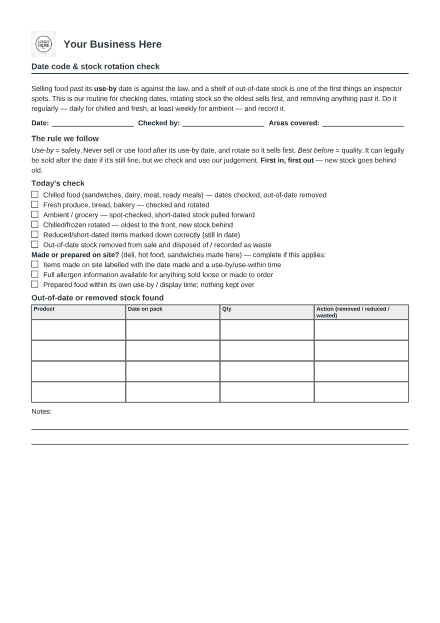
Date code & stock rotation check
Use-by dates checked, oldest stock first — before an inspector finds it.
£4 inc. VAT — yours forever, no subscription.Or get it in the Convenience Store pack — £29.
Type your business name and the preview updates in seconds — the real PDF, editable on screen or printable to fill in by pen. Nothing about your business leaves your browser.
What you need to know
The plain-English guidance that comes with this document.
- "Use-by" is a safety line you cannot cross. It's a criminal offence to sell food after its use-by date — this is about bacteria you can't see or smell, not freshness. A single out-of-date sandwich found on the shelf can trigger enforcement and wreck your food-hygiene rating. Daily date-checking of chilled and fresh food is the control, and this record is your proof you do it.
- "Best before" is different — quality, not safety. Food can legally be sold after its best-before date if it's still wholesome (a tin, a packet of biscuits). Many shops mark these down rather than bin them, which cuts waste. Know the difference and train staff on it — mixing the two up either loses you money or risks a sale you shouldn't make.
- Rotation is what makes date-checking work: first in, first out. Putting new deliveries behind existing stock, so the oldest sells first, is the single habit that stops things going out of date on the shelf. Check dates and rotate — one without the other doesn't work.
- Mark down, don't sell over. A short-dated item reduced and sold in date is good business. The same item sold a day over its use-by is an offence. Keep the reduced section tidy and in-date.
- If you prepare food, extra duties apply. A deli counter, hot food, or sandwiches made on site mean you're a food business that must be registered (free) with your council, must label what you make with allergen information, and — for food pre-packed for direct sale — must follow the full ingredient-and-allergen labelling rules (often called "Natasha's Law"). Our Food Safety pack covers this properly; this record just prompts you to keep on top of it.
- Record the removals. Noting what you pulled and why isn't bureaucracy — it's evidence you're actively managing dates, and it feeds your waste records. An inspector who sees a live date-check log treats you very differently from one who finds out-of-date stock and no system.
- Set a frequency that matches your stock and stick to it. Daily for chilled, fresh and made-on-site; weekly for ambient is a sensible baseline. Adapt to your range.
Please note: This is a template for guidance only. Adapt it to your business and check it against current law and your insurance requirements. It is not legal advice.