
Opening & closing checks
Open safe and legal, close secure — the routine that ties the day together.
£4 inc. VAT — yours forever, no subscription.Or get it in the Pub & Bar pack — £34.
Type your business name and the preview updates in seconds — the real PDF, editable on screen or printable to fill in by pen. Nothing about your business leaves your browser.
What you need to know
The plain-English guidance that comes with this document.
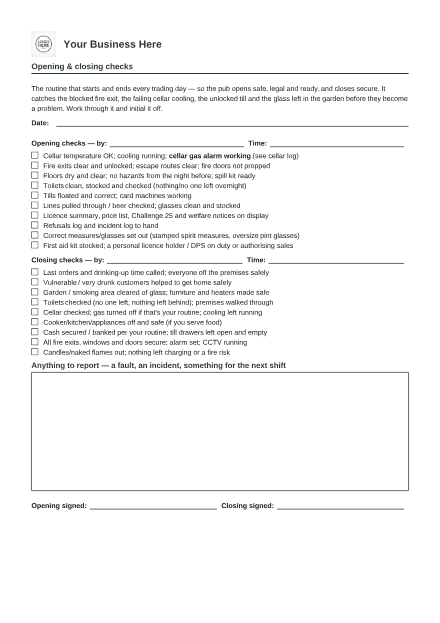
- Open safe and legal, close secure — the routine that ties the day together. A structured open-up catches the overnight problem (a warm cellar, a blocked exit, a mess) before customers arrive; a structured lock-up prevents the fire, the theft and the "who left the gas on?" moment. Doing it the same way every day, whoever's on, is what makes a pub run well.
- Fire exits are the daily non-negotiable. In a busy pub it's easy to let a fire door get propped or an exit get blocked by a delivery or stacked furniture. A locked or blocked escape route is one of the most serious fire-safety failings and a classic cause of prosecution. Check it open and close.
- The close is when customer welfare matters most. Closing time is when people are at their most vulnerable — very drunk, alone, waiting for a lift. Making sure everyone leaves safely, and helping the vulnerable get home, is both the decent thing and part of upholding your licensing objectives. The garden/smoking area is also where noise most annoys neighbours late on — clear it calmly.
- Cellar and gas get a check at both ends. Confirming the cellar cooling and the gas alarm at open, and checking the cellar at close, keeps the most dangerous part of the building on your radar every day. It links to your cellar log and gas assessment.
- Lock-up is your security and fire routine. Cash secured, tills left open and empty (so a break-in doesn't mean a smashed till), everything switched off and unplugged, exits and windows secure, alarm set, CCTV running. Most pub fires and burglaries trace back to a missed step at close.
- Use the handover box. A fault noted at close, or an incident from the night, should reach the next person on. The notes box turns the checklist into a simple shift handover.
- Make it match your pub. Add the kitchen, the function room, the outside bar, the cellar flap to the pavement — whatever you have. Drop what you don't. A checklist that fits your building gets done; a generic one gets skipped.
Please note: This is a template for guidance only. Adapt it to your business and check it against current law and your insurance requirements. It is not legal advice.