
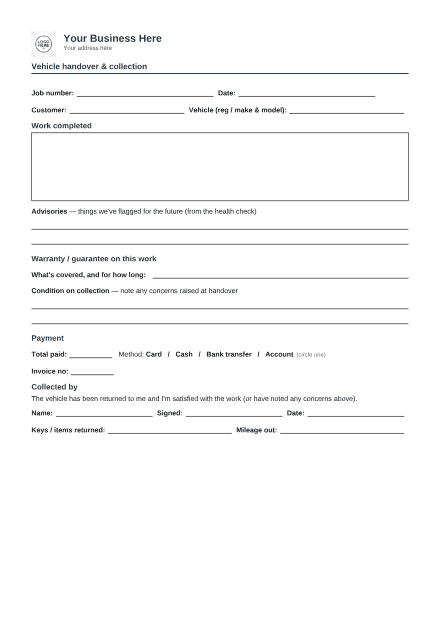
Vehicle handover & collection record
Work done, warranty, condition out and who collected — the dispute-closer.
£4 inc. VAT — yours forever, no subscription.Or get it in the Motor Trade pack — £29.
Type your business name and the preview updates in seconds — the real PDF, editable on screen or printable to fill in by pen. Nothing about your business leaves your browser.
What you need to know
The plain-English guidance that comes with this document.
- Handover is where you lock in a happy customer — and close off a dispute. A quick, clear handover — here's what we did, here's what to keep an eye on, here's your warranty — leaves the customer confident and gives you a signed record that they collected the car satisfied. It's the bookend to the job card and estimate.
- Spell out the warranty. Say what's covered (the specific work/parts) and for how long. Vague "it's guaranteed" causes arguments; a clear line means everyone knows where they stand if something recurs. Remember parts and work both carry consumer-law rights regardless.
- Note the advisories again at handover. Repeating the "amber" items from the health check — and recording that you did — both helps the customer plan and protects you if a flagged item later fails. If they declined urgent safety work, make sure that's on record.
- Record who actually collected it. Especially for account or third-party collections, note who took the vehicle and that the keys/items were returned. It closes the loop on responsibility.
- Consumer rights don't end at handover. If work turns out faulty, the customer is entitled to have it put right — so a good handover record (what was done, what was agreed) is exactly what you'll want if they come back. Keep it with the job card and invoice.
- Applies UK-wide. The Consumer Rights Act 2015 (and NI equivalent) gives customers rights over repair work and parts across the UK. A clear handover record supports you if a claim ever arises.
Please note: This is a template for guidance only. Adapt it to your business and check it against current law and your insurance requirements. It is not legal advice.