
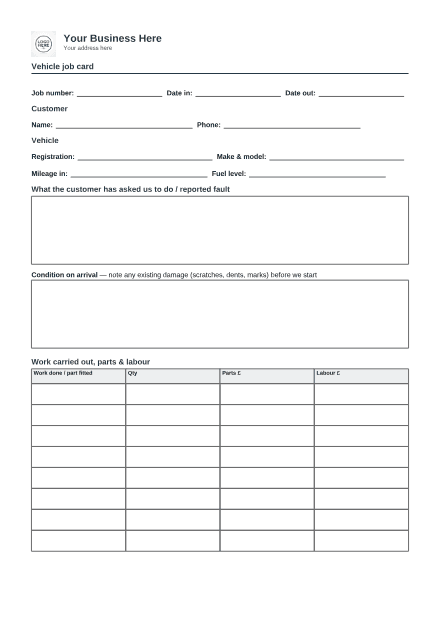
Vehicle job card / repair order
The workhorse — customer, vehicle, fault, condition and parts/labour in one place.
£7 inc. VAT — yours forever, no subscription.Or get it in the Motor Trade pack — £29.
Type your business name and the preview updates in seconds — the real PDF, editable on screen or printable to fill in by pen. Nothing about your business leaves your browser.
What you need to know
The plain-English guidance that comes with this document.
- The job card is your record of what was agreed and done. It ties the customer, the vehicle, the requested work and the parts and labour together in one place — your evidence if there's ever a query about what you were asked to do and what you charged for.
- Only do (and charge for) what's been authorised. If the customer asked for specific work, you can't add extra jobs and bill for them without their say-so. If you find more that needs doing, stop and get authorisation first (use the estimate & authorisation form) — unauthorised work is work you may not be able to charge for.
- Note the condition when it comes in — it saves the "you scratched my car" row. A quick record (and a photo or two on your phone) of existing dents and scratches at booking-in protects you against a dispute later. Do it every time, especially on nice cars.
- Record the mileage in and out. It confirms the vehicle's condition, supports service records and warranty, and heads off any "you've been joyriding in it" complaint.
- Keep it with the estimate and the invoice. The job card, the authorisation and the final invoice are one story. Kept together they make a query easy to answer and a chargeback easy to defend.
- Applies UK-wide. Consumer law (the Consumer Rights Act 2015) requires your work to be done with reasonable care and skill and charged at a reasonable or agreed price across the UK. Keep your records to show you met it.
Please note: This is a template for guidance only. Adapt it to your business and check it against current law and your insurance requirements. It is not legal advice.