Sickness and absence record
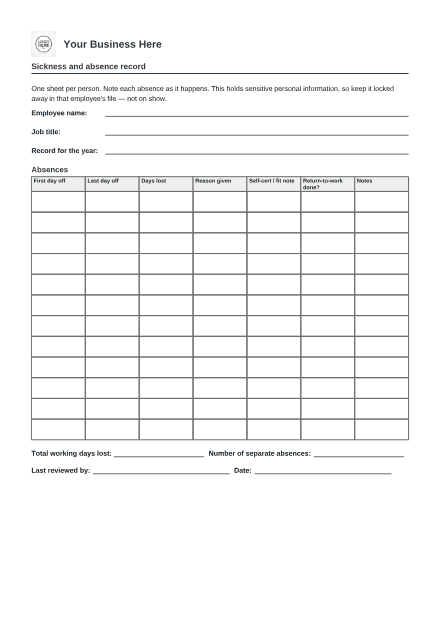
A private, one-sheet-per-person log of sickness and absence.
£4 inc. VAT — yours forever, no subscription.Or get it in the HR Essentials pack — £39.
Type your business name and the preview updates in seconds — the real PDF, editable on screen or printable to fill in by pen. Nothing about your business leaves your browser.
What you need to know
The plain-English guidance that comes with this document.
- Why this comes as a blank form. BossKit brands it with your business and leaves every detail as a line to fill in by hand — we never ask for, or hold, anything about your people. This is your own private log, one sheet per person.
- Health information is the sensitive stuff — treat it that way. Someone's sickness details are "special category" data under UK data protection law, which gets extra protection. Record only what you actually need — the dates, that it was sickness, whether they had a return-to-work chat — not a running commentary on their symptoms. The less you write, the less you have to protect.
- Self-certify for a week, fit note after that. For the first 7 calendar days off, staff can simply tell you they were unwell (self-certification) — you can't demand a doctor's note for a short absence. From the 8th day they need a fit note (the "statement of fitness for work"), which a doctor or other healthcare professional can issue. A fit note can say "may be fit for work" with adjustments — take that seriously, don't just file it.
- Sick pay is a day-one right now. Since 6 April 2026, Statutory Sick Pay starts from the first day off — the old three unpaid "waiting days" are gone — and the lower earnings limit has been removed, so lower-paid staff qualify too. The weekly rate changes each April, so check the current figure on gov.uk rather than a number you wrote down last year.
- Do a return-to-work chat every time — even for a single day. It's the moment you welcome someone back, check they're really okay, and quietly spot if something's building up. Use our return-to-work form and note here that you've done it. Patterns are far easier to help with early than to unpick months later.
- Watch for patterns, but tread very carefully around disability and pregnancy. It's fine to keep an eye on frequent short absences. But absence linked to a disability may need to be set aside rather than counted against someone — that can be a reasonable adjustment under the Equality Act. And never count pregnancy-related sickness against a member of staff; that's automatically discrimination. If in doubt, take advice before acting on the numbers.
- Keep it factual, and keep it the same for everyone. Record what happened, not what you suspect. Apply the same approach to every member of staff — inconsistency is where grievances and claims start.
- Across the UK. Statutory Sick Pay and the fit note system are the same in England, Wales, Scotland and Northern Ireland. The equality protections above apply throughout too, though in Northern Ireland they come from its own disability and equality law rather than the Equality Act 2010 — the practical effect is the same.
- Store it securely, and don't hoard it. Keep this in the employee's file under lock and key (or access-controlled if it's digital), and don't keep absence records longer than you genuinely need them.
Please note: This is a template for guidance only. Adapt it to your business and check it against current law and your insurance requirements. It is not legal advice.