
Interview record
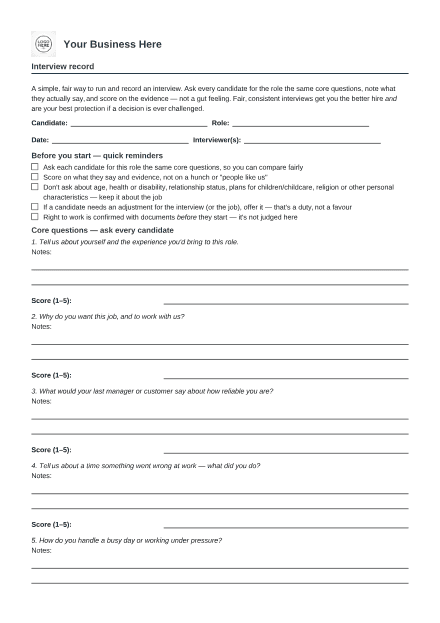
Run fair, consistent interviews — the same core questions, trade-tailored extras, notes and scoring, and a job-related decision.
£7 inc. VAT — yours forever, no subscription.Or get it in the HR Essentials pack — £39.
Type your business name and the preview updates in seconds — the real PDF, editable on screen or printable to fill in by pen. Nothing about your business leaves your browser.
What you need to know
The plain-English guidance that comes with this document.
- A structured interview is a better hire and a legal safety net. Asking every candidate for a role the same core questions, and scoring on what they actually say, is proven to pick better people than a free-flowing chat — and it's exactly what protects you if a rejected candidate ever claims the process was unfair. This form gives you that structure without turning the interview into an interrogation.
- Keep it about the job — mind the Equality Act. Steer well clear of questions about age, disability or health, marriage or relationships, plans to have children or childcare, religion, race or sexual orientation. They're not job-related and they invite a discrimination claim. In particular, you generally can't ask about health or disability before making a job offer (Equality Act 2010, s.60), apart from narrow exceptions — so no "how's your health?" or "how many days were you off sick last year?" at interview.
- Offer reasonable adjustments — for the interview and the job. If a candidate tells you they're disabled and need something to take part fairly (a different format, more time, a ground-floor room), sort it. It's a legal duty and it's the decent thing.
- Your notes can be seen by the candidate — write them accordingly. Interview notes are personal data. A candidate can ask to see what you recorded about them (a subject access request), and notes get read out at tribunals. So keep them factual, job-related and professional — evidence and scores against the questions, never personal remarks or anything you wouldn't want read back to you.
- Score against the role, then decide. Agreeing what a good answer looks like before you interview, and scoring each candidate the same way, keeps the decision honest and consistent. The total isn't a robot — use judgement — but it stops the loudest or most similar-to-you candidate winning by default.
- The trade questions swap to match your business — add your own too. BossKit fills the "questions for your trade" section with ones suited to your line of work. Treat them as a strong starting point and add a couple that are specific to this role — the best interview mixes consistent core questions with a few real ones about the actual job.
- A note on the trade fit. The tailored questions follow your business type. If you run a childcare or early-years setting, the care questions (safeguarding, values, DBS) are the closest fit — well worth using, plus your own EYFS/ratio-specific ones. If your trade isn't specifically covered, you'll get a sensible general set to build on. Whatever your trade, if the role involves children or vulnerable adults, ask about safeguarding and DBS as standard.
- Right to work is a separate step. Don't use the interview to judge someone's right to work — do the proper document check on the person you actually hire, before they start (see the right-to-work check record). Asking only certain candidates about their nationality or immigration status is itself discriminatory.
- Keep or bin the notes sensibly. Hold interview records only as long as you need them (a few months is common, in case a decision is questioned), store them securely, and dispose of them properly. Applies UK-wide; Northern Ireland has its own, closely-matching equality law.
Please note: This is a template for guidance only. Adapt it to your business and check it against current law and your insurance requirements. It is not legal advice.