
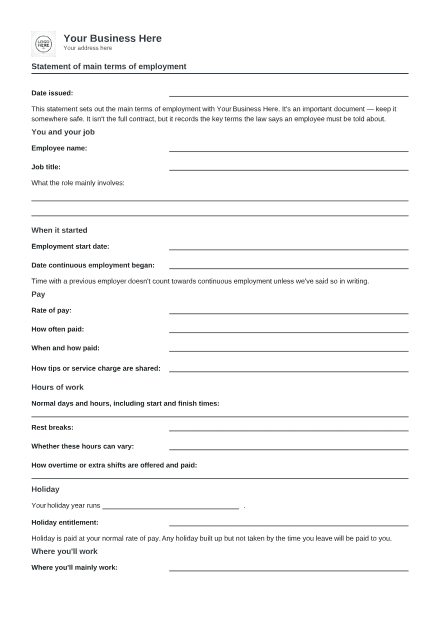
Statement of main terms
The written terms every new starter must get, on or before day one.
£14 inc. VAT — yours forever, no subscription.Or get it in the HR Essentials pack — £39.
Type your business name and the preview updates in seconds — the real PDF, editable on screen or printable to fill in by pen. Nothing about your business leaves your browser.
What you need to know
The plain-English guidance that comes with this document.
- Why this comes as a blank form. BossKit brands it with your business but leaves every staff detail as a line to fill in by hand — including the issue date, so a form sitting in the drawer isn't stamped with the day you printed it. That's deliberate: we never ask for — and never hold — anything about your people. Print a few, keep them handy, and complete one properly (dated the day you hand it over) with each new starter.
- This one's a legal must-have, and you're on the clock. In England, Wales and Scotland every employee and worker must get a written statement of their main terms on or before their first day. Not "when you get round to it" — day one. Having a stack ready to fill in means you're never caught out when someone starts on Monday.
- It's not the contract — but treat it like it matters. This statement is the legal minimum you must put in writing. If there's ever a dispute about what was agreed, this is the document people reach for. So fill it in properly, both of you sign it, and keep the signed copy.
- Where the signed copy goes matters too. Once it's completed it holds personal data, so store it securely in that employee's own file — not in the drawer with the blank stack, and not pinned up in the back room. That's a data-protection point as much as a tidiness one.
- Scotland: same rules as England and Wales. Employment law here is set at Westminster, so nothing changes north of the border.
- Northern Ireland is different — don't assume the same rules. NI has its own law (the Employment Rights (Northern Ireland) Order 1996). There, the statement can be given within two months of starting rather than on day one, and the expanded day-one list that applies in Great Britain doesn't apply. Handing it over on day one is still good practice — but if you're in NI, the deadline and exact required contents are set by NI law.
- Don't shortchange the holiday. The legal minimum is 5.6 weeks a year — that's 28 days for someone working five days a week, and you're allowed to count bank holidays inside that 28. Where people trip up: "20 days plus bank holidays" is fine and generous, but "20 days including bank holidays" is below the legal floor. Part-timers get the same 5.6 weeks worked out pro rata, so a four-day-a-week person gets 22.4 days. The "bank holidays are included / in addition" line is there so nobody has to guess — circle one, and keep your holiday request form consistent with it.
- The pre-printed lines are yours to change. Sick pay, pension contributions and where the handbook and privacy notice live print with wording that's true for most small employers. If yours differs — you pay company sick pay, contribute above the minimum, keep the handbook somewhere specific — reword those lines in the Builder before you print. Holiday year, pension scheme and tips are left for you to write in, because there's no safe guess.
- Check the pay rate against minimum wage — every April. The National Minimum and National Living Wage rates go up each April and the age bands change too, so a rate that was legal last year can quietly slip under the line. Diary a reminder to check each spring before you write pay onto a new form.
- If they earn enough, you probably have to auto-enrol them. Broadly, if someone's aged 22 or over, under State Pension age, and earning above the auto-enrolment threshold, you must put them into a workplace pension and pay in. NEST is the free government-backed scheme most small employers use — worth setting up before your first payday, not after.
- Notice cuts both ways, and there's a legal floor. Once someone's been with you a month the law says you must give at least one week's notice, rising by a week for each full year worked, up to twelve. They only owe you one week back unless you've agreed more in the blank provided. You can offer more than the minimum — never less.
- Tips: there's a law now, so don't wing it. Since October 2024, if tips come in more than occasionally you must pass on 100% of them to staff (you can't skim a "card fee"), share them out fairly, and have a written tips policy staff can see. Keep tipping records for three years. If your place takes card tips, fill the tips line in and point staff to that policy — this is one HMRC and staff both care about.
- Only promise other-site working if it's real. The "other sites" line matters for anyone mobile — a plumber, a cleaner, a multi-site owner. But don't tick it just in case: if you later need to move someone and it isn't written down, you can't just spring it on them. Write down what's genuinely true for the role.
- Once these forms are filled in, you're a data controller — act like one. The irony isn't lost on us: BossKit holds nothing about your staff, but the moment you complete one of these you do. That's why there's a privacy-notice line — a short note telling staff what data you hold and why. Keep completed forms locked away in each person's file, and don't hang on to them forever after someone leaves.
- This isn't the full contract — keep it that way. Confidentiality, intellectual property, a list of sackable offences, a full equality policy — people sometimes ask why those aren't here. They belong in your contract or handbook, not the statutory statement. Cramming them in just makes the one document a new starter actually reads longer and scarier. Keep this lean and let the handbook carry the detail.
- What's changing (2026–27), and why we've built it in. From April 2026, statutory sick pay and paternity/parental leave became day-one rights, so the old waiting days are gone. From October 2026 the statement is expected to have to include a line reminding staff of their right to join a trade union — we've put that line in already. And from January 2027 the qualifying period for ordinary unfair dismissal drops to six months (it was two years), so a long probation is no longer the safety net it once was — keep honest notes on how a new starter is getting on.
Please note: This is a template for guidance only. Adapt it to your business and check it against current law and your insurance requirements. It is not legal advice.