
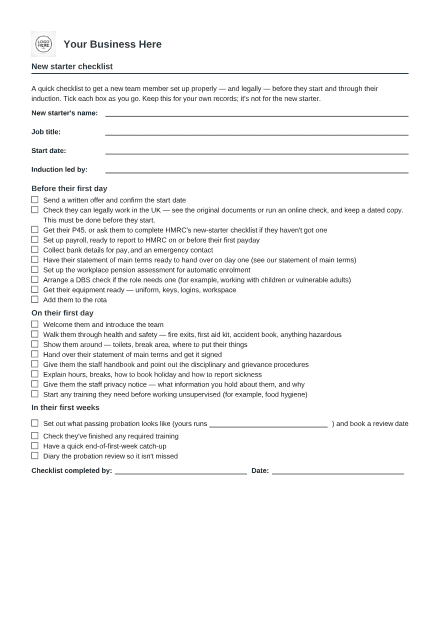
New starter checklist
Your private tick-list to get someone set up properly — right to work, payroll, induction.
£7 inc. VAT — yours forever, no subscription.Or get it in the HR Essentials pack — £39.
Type your business name and the preview updates in seconds — the real PDF, editable on screen or printable to fill in by pen. Nothing about your business leaves your browser.
What you need to know
The plain-English guidance that comes with this document.
- Why this comes as a blank form. BossKit brands it with your business and leaves every staff detail as a line to fill in by hand — we never ask for, or hold, anything about your people. This one's your own working copy, so keep it in that person's file once it's done.
- Right to work is the box you cannot skip. Check that anyone you take on can legally work in the UK, and do it before their first shift. A proper check — original documents seen in person, or a Home Office online check, with a dated copy kept — gives you a "statutory excuse" if it later turns out they couldn't. Get it wrong and the civil penalty is up to £45,000 per worker for a first breach, and £60,000 for a repeat. This isn't a place to trust your gut.
- Check everyone the same way. It's tempting to only check people who "sound foreign" — don't. Singling people out is race discrimination in its own right. Same check, every new starter, no exceptions. British-born staff still need to show you a passport or the like.
- From October 2026 the net gets wider. From 1 October 2026 the duty to check stretches beyond employees to cover some people you take on as contractors, casual or gig workers. If you use subcontractors — a self-employed cleaner, a delivery rider — check them too, or you could be on the hook.
- Tell HMRC before the first payday, even for one person. As soon as you're paying someone, you're running PAYE. Report the new starter to HMRC on or before their first payday using their P45 or the HMRC new-starter checklist — not weeks later.
- The statement of main terms is a day-one job. In England, Wales and Scotland they must have it on or before their first day (Northern Ireland allows two months — see that document). Pairing it with this checklist keeps you honest.
- DBS goes by a different name across the UK. You can only DBS-check roles that legally qualify — you can't run one on just anyone. And it's the Disclosure and Barring Service in England and Wales, Disclosure Scotland (the PVG scheme) in Scotland, and AccessNI in Northern Ireland. Use the right one for where you are.
- Keep the paperwork, and keep it locked away. Once filled in, this checklist and your right-to-work copies hold personal data — store them securely in the employee's file, not on the counter. Hang on to right-to-work evidence for the whole time they work for you, plus two years after they leave.
Please note: This is a template for guidance only. Adapt it to your business and check it against current law and your insurance requirements. It is not legal advice.