
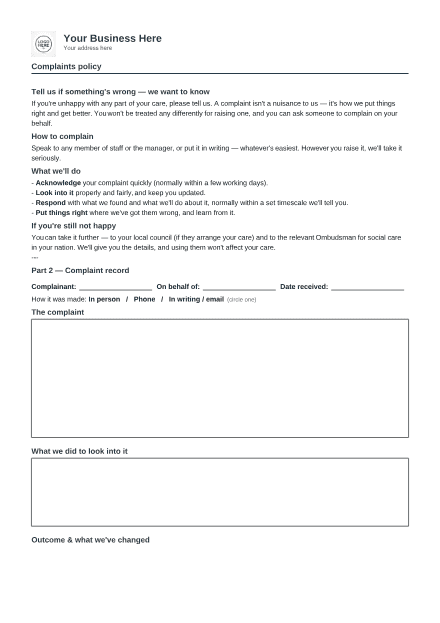
Complaints policy & record
An accessible complaints process + record, with the ombudsman routes.
£7 inc. VAT — yours forever, no subscription.Or get it in the Care Services pack — £49.
Type your business name and the preview updates in seconds — the real PDF, editable on screen or printable to fill in by pen. Nothing about your business leaves your browser.
What you need to know
The plain-English guidance that comes with this document.
- Having a clear complaints process is a regulatory requirement — and a gift. Regulators expect care providers to have an accessible complaints procedure and to act on complaints. But beyond compliance, complaints are the cheapest, most honest feedback you'll ever get — the providers that welcome them are the ones that improve.
- Make it genuinely easy, and safe. People receiving care are often reluctant to complain — they worry it'll affect how they're treated. Say clearly (and mean it) that it won't, and let people complain through an advocate, family member or friend.
- Acknowledge fast, respond within your timescale, and keep them posted. The thing that turns a complaint into a formal escalation is silence. Set timescales, meet them, and keep the person updated even if the answer's taking a while.
- Record every complaint and what you learned. A log of complaints and actions shows an inspector you take feedback seriously and improve from it — and patterns in complaints often reveal a real problem before it becomes a crisis.
- Know the escalation route. In England, unresolved complaints can go to the Local Government and Social Care Ombudsman (for arranged care) or the CQC is told about concerns; the other nations have their own ombudsman and regulator routes. Give people the details rather than hoping they don't ask.
- Professionally structured starting point — adapt and sign off. A registered manager tailors the timescales and escalation contacts to your service and nation; it's not "compliant out of the box".
- Applies UK-wide, with different ombudsmen. England: Local Government & Social Care Ombudsman. Wales: Public Services Ombudsman for Wales. Scotland: Scottish Public Services Ombudsman / Care Inspectorate. Northern Ireland: NI Public Services Ombudsman / RQIA. Use the right one.
Please note: This is a template for guidance only. Adapt it to your business and check it against current law and your insurance requirements. It is not legal advice.