
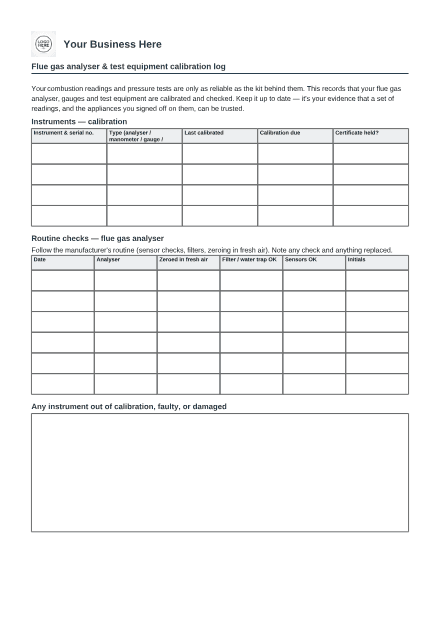
Flue gas analyser & test equipment calibration log
Calibrated analyser, honest gauges — what makes your readings trustworthy.
£4 inc. VAT — yours forever, no subscription.Or get it in the Plumbing & Heating (Gas) pack — £34.
Type your business name and the preview updates in seconds — the real PDF, editable on screen or printable to fill in by pen. Nothing about your business leaves your browser.
What you need to know
The plain-English guidance that comes with this document.
- A reading from an uncalibrated analyser is worth very little — this log protects every appliance you sign off. Combustion analysis is how you prove an appliance is burning safely, and a tightness test proves an installation is sound. If the analyser or gauge has drifted, every result it gave is in doubt — and so is the safety of the appliances you passed. Regular calibration, recorded here, is what lets you and anyone else trust the numbers. Analysers are typically calibrated at least annually — follow your manufacturer's interval.
- Between calibrations, do the manufacturer's routine checks. Zeroing in fresh air, checking the water trap and filter, and letting sensors settle are daily-use habits that keep readings honest and the instrument healthy. A blocked filter or a tired sensor gives bad numbers long before the annual calibration is due.
- Your tightness-test kit counts too. Manometers and gauges used for gas tightness and working-pressure tests need to be accurate and in good order — a faulty gauge can pass a leaking installation or condemn a sound one. Keep them on this log alongside the analyser.
- If an instrument fails, think about the jobs behind it. An out-of-calibration analyser isn't just a kit problem — you may need to consider the appliances you signed off since it last read true. Withdraw it, note it here, and decide whether any recent jobs need re-checking. That honesty protects you and your customers.
- Keep your calibration certificates with this log. The log is the index; the calibration certificates are the proof. Together they answer "how do I know your readings are valid?" — a question that comes up in warranty claims, incident investigations and commercial work.
- Adapt it to your kit. Different analysers and gauges have different routines — follow the manufacturer's, record what you do, and keep the completed sheets as your evidence trail.
Please note: This is a template for guidance only. Adapt it to your business and check it against current law and your insurance requirements. It is not legal advice.