
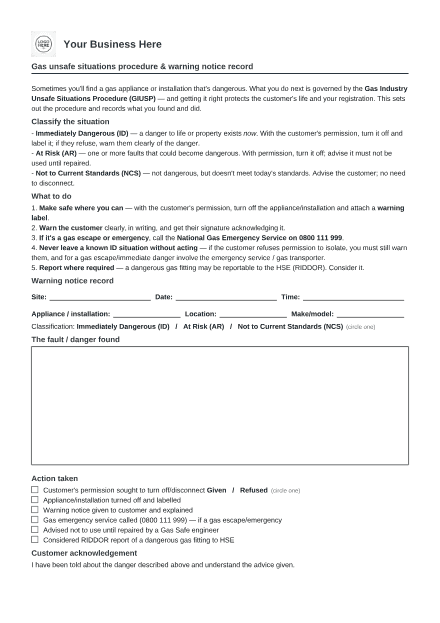
Gas unsafe situations procedure & warning notice
ID, AR, NCS — what to do when you find danger, and the signed warning that proves it.
£14 inc. VAT — yours forever, no subscription.Or get it in the Plumbing & Heating (Gas) pack — £34.
Type your business name and the preview updates in seconds — the real PDF, editable on screen or printable to fill in by pen. Nothing about your business leaves your browser.
What you need to know
The plain-English guidance that comes with this document.
- This is the procedure that protects lives — and your registration — when you find danger. Every gas engineer eventually walks into an Immediately Dangerous situation: a dodgy flue, a leaking joint, spillage of combustion products into a room. What you do in that moment is defined by the Gas Industry Unsafe Situations Procedure, and doing it properly (and recording it) is both a professional duty and your protection if there's ever a question later.
- Learn the classifications cold: ID, AR, NCS. Immediately Dangerous means danger now — act. At Risk means it could become dangerous — turn off with permission and advise. Not to Current Standards means it's safe to use but dated — advise, don't disconnect. Miscategorising the other way (calling an ID situation "NCS" and walking away) is how people die and how registrations are lost.
- You need permission to turn off — but you must always warn. You can't force disconnection, but you can and must make the danger unmistakably clear, in writing, and get the customer's signature that they were told. If they refuse to let you isolate an Immediately Dangerous appliance, that warning — and, for a gas escape, a call to the emergency service — is exactly what protects them and you.
- 0800 111 999 is the number that matters. For a gas escape or an immediate gas emergency, the National Gas Emergency Service is the right call, day or night. Make sure it's on your van, your paperwork and your team's phones.
- A dangerous gas fitting may be RIDDOR-reportable. Certain dangerous gas fittings must be reported to the HSE. Build the habit of asking "does this need reporting?" — most won't, but the ones that do really matter.
- The signed warning notice is the whole point of the record. A verbal "you shouldn't use that" evaporates in a dispute. A signed notice showing you identified the danger, classified it, made it safe (or were refused), and warned the customer is robust evidence you did the right thing. Leave the customer a copy and keep one.
- This is the procedure — your professional judgement applies the detail. GIUSP has fuller guidance and decision charts; use them. This document is your on-the-job aid and record, not a replacement for the current procedure and your training.
Please note: This is a template for guidance only. Adapt it to your business and check it against current law and your insurance requirements. It is not legal advice.