
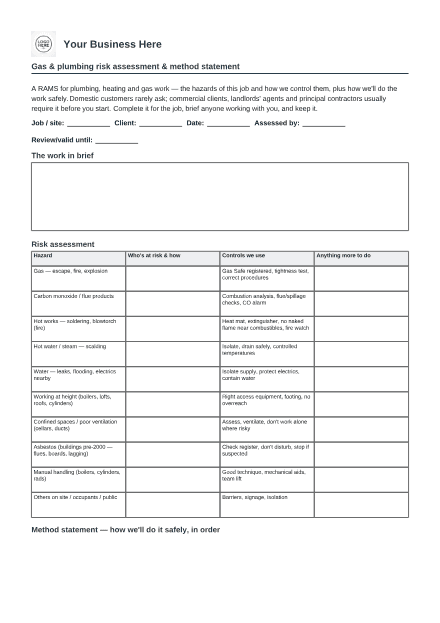
Gas & plumbing risk assessment & method statement (RAMS)
The RAMS commercial clients ask for — gas, CO, hot works, scalding, asbestos.
£14 inc. VAT — yours forever, no subscription.Or get it in the Plumbing & Heating (Gas) pack — £34.
Type your business name and the preview updates in seconds — the real PDF, editable on screen or printable to fill in by pen. Nothing about your business leaves your browser.
What you need to know
The plain-English guidance that comes with this document.
- Commercial and landlord work often won't start without a RAMS — this is your passport onto site. Domestic customers rarely ask, but agents, facilities managers and principal contractors almost always require a risk assessment and method statement first. A ready, professional RAMS you can tailor in minutes wins and keeps that work.
- Two hazards define gas work: the gas itself, and carbon monoxide. Escapes, fire and explosion are the obvious risk; CO — colourless, odourless, and produced by incomplete combustion — is the silent one. Your tightness test, flue and spillage checks and combustion analysis are the controls, and a working CO alarm is the backstop. Never sign off an appliance you haven't proven safe.
- Hot works cause fires — plan for them. Soldering and brazing with a naked flame near joists, insulation or a customer's belongings is a classic cause of property fires, sometimes hours after you've left. A heat mat, an extinguisher to hand, keeping flame away from combustibles, and a few minutes' fire watch before you go are simple, essential controls.
- Water and electricity together, and scalding, are the everyday injuries. Isolating and draining safely, protecting nearby electrics, and controlling hot water and steam prevent the burns, shocks and floods that make up most plumbing incident reports. Isolate first, always.
- Asbestos hides where you drill and cut in older properties. Pre-2000 buildings can contain asbestos in flue components, boiler flash-guards, lagging, textured coatings and boards. Check the register on commercial sites, and if you find or suspect it, stop — don't cut or break it. The Safety pack's asbestos and COSHH material backs this up.
- A method statement is you thinking the job through before you're on your knees behind a boiler. Writing the sequence — survey, isolate gas/water/electric, do the work, test, commission, hand back — forces you to spot the awkward bit in advance (the shared flue, the occupied flat, the cylinder you can't get down the stairs alone).
- Brief whoever's with you. An apprentice or mate needs to know the isolation plan and the hazards. Record that you told them.
- Keep it proportionate. A tap washer doesn't need three pages; a boiler swap in an occupied HMO does. Scale the detail to the risk, and pair this with the unsafe situations procedure and the Safety pack (COSHH, working at height, manual handling) for the full picture.
Please note: This is a template for guidance only. Adapt it to your business and check it against current law and your insurance requirements. It is not legal advice.