
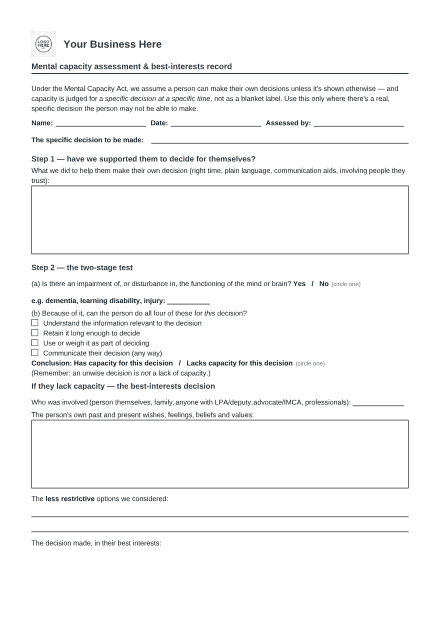
Mental capacity assessment & best-interests record
Capacity assessment + best-interests — MCA five principles, DoLS.
£14 inc. VAT — yours forever, no subscription.Or get it in the Care Services pack — £49.
Type your business name and the preview updates in seconds — the real PDF, editable on screen or printable to fill in by pen. Nothing about your business leaves your browser.
What you need to know
The plain-English guidance that comes with this document.
- Start by assuming capacity — this form is the exception, not the routine. The Mental Capacity Act's first principle is that everyone is presumed able to make their own decisions. You only assess capacity where there's a genuine, specific reason to doubt it for a particular decision. Don't use it to override choices you simply disagree with.
- The five principles run through everything. Presume capacity; give all practicable help to decide; an unwise decision isn't incapacity; act in best interests if they can't decide; and always choose the least restrictive option. Keep all five in mind.
- Capacity is decision- and time-specific. Someone may be able to decide what to eat but not manage complex finances, and capacity can come and go. Assess the actual decision in front of you, at the time — never "they've got dementia, so they can't decide anything".
- Best interests is a process, not a hunch. If someone can't make the decision, work out what's in their best interests — involving them, their family, anyone with a lasting power of attorney or deputy, and (where there's no one to consult on a serious decision) an independent advocate/IMCA. Weigh their known wishes heavily.
- Deprivation of liberty needs proper authorisation. If your care would deprive someone of their liberty (continuous supervision and control, not free to leave), that must be lawfully authorised. In 2026 this is still done under the Deprivation of Liberty Safeguards (DoLS) for care homes and hospitals (via the local authority), and through the Court of Protection for other settings such as someone's own home. The Liberty Protection Safeguards (LPS) are planned but not yet in force (earliest 2027) — so keep using DoLS and check the current position with your local authority.
- Covert medication and serious restrictions hinge on this. Hiding medicine, locking doors, or restricting contact can only be lawful for someone who lacks capacity for that decision, as a recorded best-interests decision. Get it right here first.
- Professionally structured starting point — get it signed off. Capacity and best-interests decisions carry real legal weight; a registered manager or trained assessor must tailor and sign these, and complex cases need professional advice. Not "compliant out of the box".
- Applies UK-wide, with different law in Scotland. The Mental Capacity Act 2005 covers England and Wales; Scotland uses the Adults with Incapacity (Scotland) Act 2000; Northern Ireland has the Mental Capacity Act (NI) 2016 (being implemented in stages). Use your nation's law.
Please note: This is a template for guidance only. Adapt it to your business and check it against current law and your insurance requirements. It is not legal advice.