
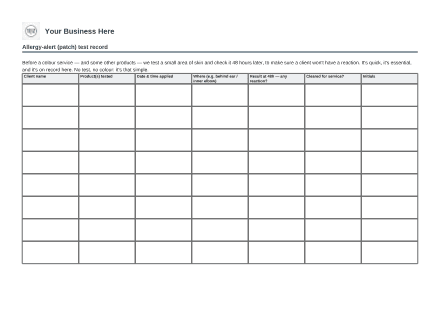
Allergy-alert (patch) test record
Your patch-test log — the insurer's condition for any colour service.
£7 inc. VAT — yours forever, no subscription.Or get it in the Salon & Beauty pack — £29.
Type your business name and the preview updates in seconds — the real PDF, editable on screen or printable to fill in by pen. Nothing about your business leaves your browser.
What you need to know
The plain-English guidance that comes with this document.
- No test, no colour — even for regulars. An allergy-alert (skin) test before a colour service isn't a formality; a reaction to hair dye can be serious, and it can develop suddenly in someone who's been coloured for years with no problem. Do it at least 48 hours before the service, every time your manufacturer's instructions say to — and don't let a rushed client talk you out of it. The same goes for lash and brow tints and lash adhesives.
- PPD is the big culprit. Para-phenylenediamine (PPD) and related chemicals in permanent and dark colours are the common cause of dye allergy — and reactions range from an itchy scalp to hospital. Follow the manufacturer's testing instructions for the exact product you'll use, because different products test differently.
- Record the 48-hour check, not just the application. Applying the test is half the job; the record has to show it was actually read at 48 hours and by whom. If the client checked it at home and phoned or texted, write that — "client reported by text, no reaction" — and get them to sign the line when they come in. A test with no recorded result is no test at all to an insurer.
- Test the actual product, and re-test when things change. The test only means something if it's the product you'll actually use. Re-test if the client hasn't been in for a while, if you're changing brand or shade type, if they've had a reaction anywhere, or after events that can change sensitivity (like a recent tattoo, which shares chemicals with some dyes). When in doubt, test.
- Warn about "black henna". Temporary "black henna" tattoos (often abroad) contain high levels of PPD and can sensitise someone badly — a client who's had one may react violently to hair dye afterwards. Ask, and take extra care.
- Under-16s: don't colour. Hair colour and most tints aren't intended for under-16s — it's on the product instructions — and insurers exclude them. A patch test doesn't change that.
- It's a common insurance condition. Salon treatment insurance almost always requires patch testing to its terms. Skipping it can void your cover for a colour claim — so the two minutes protects the client and the business.
- Applies UK-wide. Patch/allergy-alert testing is standard practice and an insurance expectation across the UK. Always follow the specific product manufacturer's current instructions.
Please note: This is a template for guidance only. Adapt it to your business and check it against current law and your insurance requirements. It is not legal advice.