
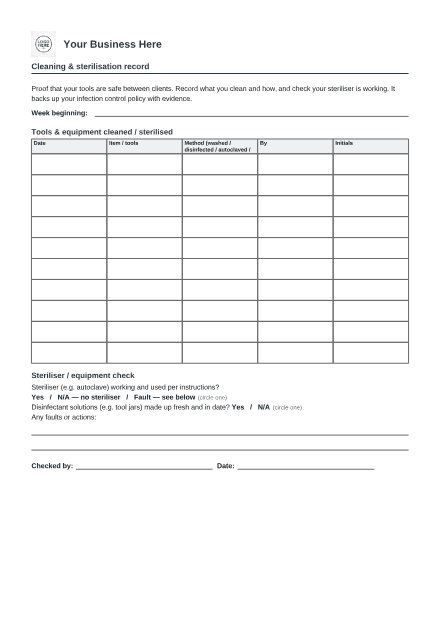
Cleaning & sterilisation record
Proof your tools are safe between clients.
£4 inc. VAT — yours forever, no subscription.Or get it in the Salon & Beauty pack — £29.
Type your business name and the preview updates in seconds — the real PDF, editable on screen or printable to fill in by pen. Nothing about your business leaves your browser.
What you need to know
The plain-English guidance that comes with this document.
- A record turns "we always clean our tools" into proof. Everyone says they clean up; this shows it. If a client ever raises an infection, or an inspector asks, a kept, dated record is the difference between your word and evidence. One sheet a week, a tick a day — it's simple and it's worth it.
- Tick it when it's done, not on Friday for the week. A sheet ticked in one pen in one sitting is obvious, and it's worth less than nothing to an inspector. Make it part of closing up: check, tick, initial.
- Match the method to the risk. Tools that only touch clean, intact skin or hair can be washed and disinfected (an approved solution or barbicide jar, made up fresh). Anything that could touch blood or broken skin must be single-use and binned, or sterilised in an autoclave — disinfectant alone isn't enough for those.
- A barbicide-type jar only works if it's fresh and tools are clean first. Solutions lose strength and get dirty — make them up fresh as the label says, and clean visible debris off tools before they go in. A cloudy jar of old solution is doing nothing.
- If you use an autoclave, log every cycle. Date, cycle number, what was in it, that it reached temperature and time, and that the indicator strip or tape changed — that's what shows the tools actually came out sterile. Follow the manufacturer's maintenance, and if it's playing up, note it and stop using it until it's checked. A steriliser that isn't working properly gives false confidence — the worst kind.
- Foot spas count. Pedicure basins and whirlpool spas have caused real outbreaks; they're on the daily grid for a reason. Drain, clean and disinfect between clients.
- Sharps and clinical waste, not the bin. Needles, blades and blood-contaminated items go into a proper sharps or clinical waste container, collected by a licensed waste carrier. The daily check is there to catch an overfull or open bin.
- It pairs with your infection control policy. The policy says what you do; this record shows you did it. Keep them together, and keep the completed sheets — a year's worth is a good habit.
- Applies UK-wide. Tool hygiene expectations are consistent across the UK; extra rules apply to skin-piercing treatments (registration or licensing) — see your infection control policy and check with your local council.
Please note: This is a template for guidance only. Adapt it to your business and check it against current law and your insurance requirements. It is not legal advice.