
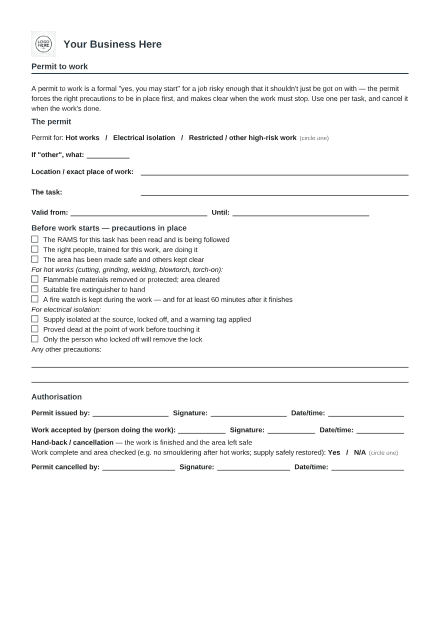
Permit to work
Formal go/no-go for hot works, electrical isolation and other high-risk tasks.
£7 inc. VAT — yours forever, no subscription.Or get it in the Construction RAMS pack — £49.
Type your business name and the preview updates in seconds — the real PDF, editable on screen or printable to fill in by pen. Nothing about your business leaves your browser.
What you need to know
The plain-English guidance that comes with this document.
- A permit is a discipline, not paperwork. Its whole point is to stop a risky job starting until the precautions are actually in place, and to make the end of the work a deliberate moment (checked and cancelled) rather than everyone just wandering off. Use it for the jobs that genuinely warrant it — hot works, electrical isolation, restricted access — not for everything.
- Hot works cause fires that start after you've finished. Cutting, grinding, welding and torch-on roofing throw sparks and heat that can smoulder unseen for a long time. That's why the fire watch continues for at least an hour after the work stops — most hot-work fires take hold once everyone's packed up. Clear the area, keep an extinguisher to hand, and don't skip the after-check.
- Electrical isolation: lock off, tag, prove dead — in that order. Isolate at the source, lock it so no one can switch it back on, tag it so everyone knows why, and then prove it's dead at the point you'll be working before you touch anything. The person who applied the lock is the only one who removes it. Assuming a circuit is dead without proving it is how people get killed.
- Confined spaces are NOT this permit. Entering a confined space — a tank, a chamber, an unventilated void — is specialist, high-hazard work that needs its own confined-space permit, atmosphere testing and a rescue plan, and is often a job for a specialist contractor. If that's what you're facing, stop and get the right expertise; don't use this form and press on.
- One task, one permit, and cancel it. A permit covers a specific task for a specific window. When the job's done, check the area's safe and formally cancel the permit — an open permit that everyone's forgotten about is worse than none.
- The permit sits under the RAMS. The RAMS is the plan for the job; the permit is the go/no-go control for the risky bit within it. Reference the RAMS on the permit so they work together.
- Applies UK-wide. Permit-to-work is recognised good practice across the UK and supports duties under CDM 2015, the Work at Height and electricity-at-work rules (HSE; HSENI in Northern Ireland).
Please note: This is a template for guidance only. Adapt it to your business and check it against current law and your insurance requirements. It is not legal advice.