
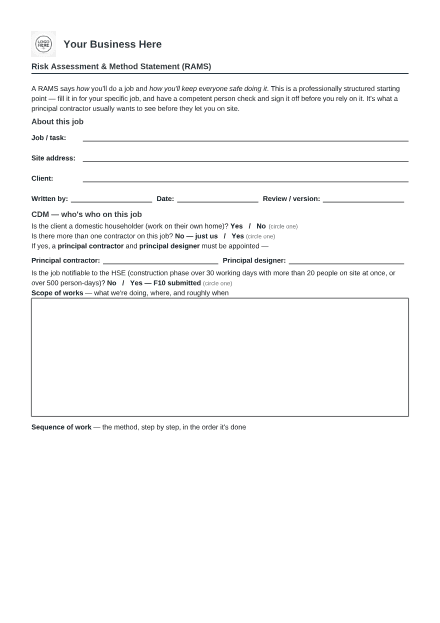
RAMS template (Risk Assessment & Method Statement)
The RAMS a principal contractor asks for — filled in per job.
£14 inc. VAT — yours forever, no subscription.Or get it in the Construction RAMS pack — £49.
Type your business name and the preview updates in seconds — the real PDF, editable on screen or printable to fill in by pen. Nothing about your business leaves your browser.
What you need to know
The plain-English guidance that comes with this document.
- A starting point you make yours — not a document you file blank. This template is professionally structured and covers the right ground, but a RAMS only works if it describes your actual job: the real sequence, the real hazards, the real controls. Fill it in for the specific job, and — because this is the highest-risk content there is — have a competent person (yours, or a construction health-and-safety adviser) check and sign it off. Never hand over a generic RAMS as if it were "compliant out of the box"; it isn't, and a good principal contractor will see straight through it.
- RAMS = the two things together. The method statement is how you'll do the job, step by step. The risk assessment is what could go wrong and how you'll stop it. A principal contractor asks for both as one document before letting you start — this gives you that, in a form you can actually complete.
- Know your CDM place — it bites on domestic jobs too. The Construction (Design and Management) Regulations 2015 apply even when you're working on someone's house. On a domestic job the client's legal duties usually pass to you (the contractor), or to the principal contractor if there's more than one contractor. And any job with more than one contractor legally needs a principal contractor and a principal designer appointed. Most small jobs aren't notifiable to the HSE, but larger ones are (over 30 working days with 20+ people on site at once, or over 500 person-days) — check before you start.
- Write the sequence like you'd explain it to a new lad. Plain, ordered steps — set up, do the work, clear up — with the safety built into each step, not bolted on at the end. If you can't write the method simply, you probably haven't thought it through yet.
- Emergency and rescue isn't optional — especially at height or with isolation. If someone falls in a harness, or gets hurt where they can't easily be reached, "call 999" isn't a plan. Say who does what, how you'd get them down or out, where the first aid kit is, and the exact address to give the ambulance. This is the section people skip and regret.
- Everyone signs, and everyone means it. The sign-on isn't box-ticking — it's the record that the people doing the work actually know the method and the risks. Brief it, don't just circulate it, and add anyone who joins the job later.
- Some tasks are beyond a template — stop and get a competent person. Asbestos removal, confined spaces, deep excavations and temporary works, scaffold design, lifting plans, large or fragile roof work, working on the live highway, and structural demolition are specialist, high-hazard jobs that need a named competent person and a job-specific assessment — not a self-serve RAMS. Use this template for the everyday tasks; for those, get the right expert.
- Review it for every job, and when things change. A RAMS is per-job, not once-and-done. If the work, the site, the weather or the team changes, revisit it. Keep the signed copy with your job records.
- Applies UK-wide. CDM 2015 and the Work at Height Regulations apply across Great Britain (HSE); Northern Ireland has equivalent construction and safety law (HSENI). The approach is the same.
Please note: This is a template for guidance only. Adapt it to your business and check it against current law and your insurance requirements. It is not legal advice.