
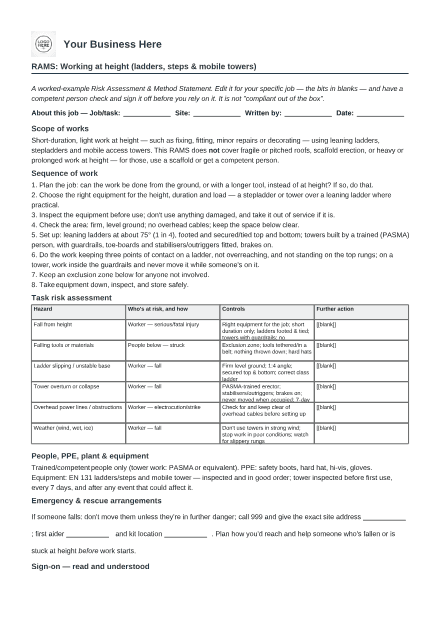
RAMS — Working at height (ladders, steps & mobile towers)
Ladders, steps and mobile towers — construction's #1 risk, done safely.
£14 inc. VAT — yours forever, no subscription.Or get it in the Construction RAMS pack — £49.
Type your business name and the preview updates in seconds — the real PDF, editable on screen or printable to fill in by pen. Nothing about your business leaves your browser.
What you need to know
The plain-English guidance that comes with this document.
- Falls from height are the number-one killer in construction — this is the RAMS to get right. The law (Work at Height Regulations 2005) sets a simple order: avoid working at height if you can; if you can't, prevent falls with the right equipment; and where a risk remains, reduce the distance and consequences. Work through it in that order, don't just reach for the nearest ladder.
- Ladders are for low-risk, short-duration work only. They're legal and fine for quick jobs where a safer option isn't reasonable — but not for heavy, awkward or long jobs. If you'd be up there more than around half an hour, or leaning and stretching, use a tower or a scaffold instead.
- Towers need a trained erector and the full kit. Build to the instructions, fit the guardrails, toe-boards and stabilisers, and never move a tower with someone on it. A part-built or fiddled tower is how people fall.
- Know where this stops. Fragile roofs, roof edges, prolonged or heavy work at height, and anything a ladder or standard tower can't safely reach are beyond this RAMS — get a scaffold or a competent person. Don't stretch a ladder method to cover a scaffold job.
- Have a rescue plan, not just "call 999". Especially for tower or awkward-access work, know in advance how you'd get an injured person down safely.
- This is a starting point — get it signed off. Edit the scope, method and actions for your actual job, and have a competent person review and sign it before you use it. Review it per job and if conditions change (weather, ground, the task).
Please note: This is a template for guidance only. Adapt it to your business and check it against current law and your insurance requirements. It is not legal advice.