
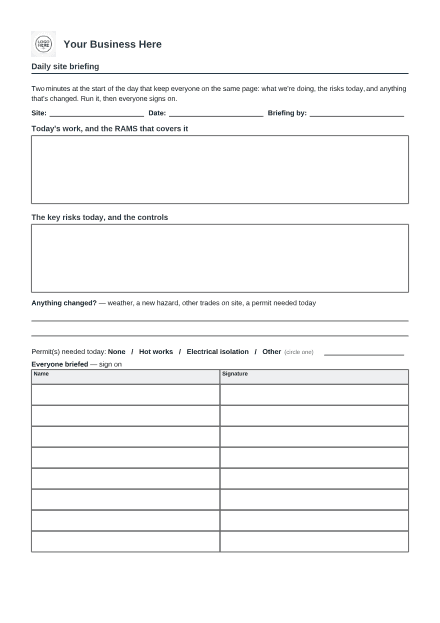
Daily site briefing
The two-minute start-of-day briefing tied to the day's RAMS.
£4 inc. VAT — yours forever, no subscription.Or get it in the Construction RAMS pack — £49.
Type your business name and the preview updates in seconds — the real PDF, editable on screen or printable to fill in by pen. Nothing about your business leaves your browser.
What you need to know
The plain-English guidance that comes with this document.
- This is where the RAMS meets the actual day. A RAMS is written before the job; the daily briefing is where you turn it into "right, today we're doing this, watch out for that." It's the moment to flag what's changed since the plan — the rain that's made the scaffold slippery, the other trade now working below you, the delivery blocking the exit.
- Keep it genuinely short. A good briefing is a focused couple of minutes stood by the work, not a meeting. If it drags, people switch off and it stops protecting anyone. Say the tasks, the top risks, the changes, and go.
- Changes are the whole point. Sites change hour to hour, and yesterday's safe plan can be today's hazard. The "anything changed?" line is the most valuable part — weather, new trades, a fresh hazard, or a task that now needs a permit.
- It doesn't replace the RAMS or the induction. The briefing is the daily top-up, not the safe system of work itself. New people still get a full induction; the task still has its RAMS. Point back to them rather than trying to cram everything into the morning huddle.
- Sign-on keeps it honest. The signatures are the record that people were actually briefed. It also doubles as a rough who's-on-site-today, useful if you need to account for everyone in a hurry.
- Applies UK-wide. Daily briefing / toolbox talks are recognised good practice everywhere and support your CDM 2015 duties to inform and instruct (HSE; HSENI in Northern Ireland).
Please note: This is a template for guidance only. Adapt it to your business and check it against current law and your insurance requirements. It is not legal advice.