
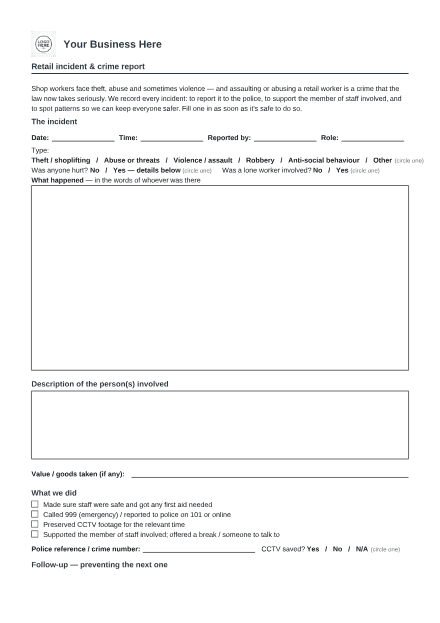
Retail incident & crime report
Theft, abuse or worse — recorded properly, reported, and learned from.
£7 inc. VAT — yours forever, no subscription.Or get it in the Convenience Store pack — £29.
Type your business name and the preview updates in seconds — the real PDF, editable on screen or printable to fill in by pen. Nothing about your business leaves your browser.
What you need to know
The plain-English guidance that comes with this document.
- Retail crime is a real, rising risk for shop workers — record it properly. Theft, threats and violence against convenience-store staff have climbed sharply, and abusing or assaulting a retail worker is treated as a serious offence (in England and Wales it's now a specific standalone offence; Scotland has had protection for retail workers in law since 2021). A clear, contemporaneous report is what turns "another bad day" into something the police can act on and something you can learn from.
- Report it — under-reporting is the enemy. Many incidents never reach the police because staff assume "nothing will happen." Report every crime (999 in an emergency, otherwise 101 or online) and record the crime number here. Police prioritise areas and individuals by reported volume — silence keeps your shop off their radar.
- Preserve the CCTV straight away. Systems overwrite themselves, often within days. The moment something happens, save and export the relevant footage — it's the single most useful piece of evidence and the easiest to lose.
- Look after the person first. Being robbed, threatened or assaulted is frightening, and the effect can last well beyond the shift. Make sure the member of staff is safe, offer a break or someone to talk to, and take it seriously. A supported team reports incidents and stays; an unsupported one doesn't.
- Lone working sharply raises the stakes. A member of staff alone — especially early, late, or cashing up — is more vulnerable and has no immediate backup. If your report keeps flagging lone workers, that's a signal to review how (and whether) people work alone, cash-handling routines, panic alarms and opening/closing procedures. Our Safety pack's lone-working assessment pairs with this.
- Use the pattern. Repeated theft of the same lines, the same individual, the same time of day — the reports together tell you where to put a security measure, a product-protection tag, or a word with the local policing team or your local Business Crime Reduction Partnership. A ban letter to a persistent offender starts with records like these.
- It holds personal data — handle it with care. Descriptions and CCTV of identifiable people are personal data; keep reports secure, share them only with the police and those who need them, and don't keep them longer than you need. Adapt the form to your shop and your area's realities.
Please note: This is a template for guidance only. Adapt it to your business and check it against current law and your insurance requirements. It is not legal advice.