
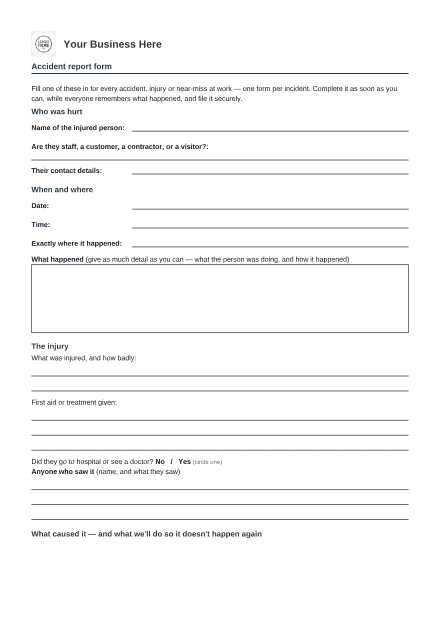
Accident report form
One form per incident — with the RIDDOR reporting steps built in.
£7 inc. VAT — yours forever, no subscription.Or get it in the Safety Records pack — £29.
Type your business name and the preview updates in seconds — the real PDF, editable on screen or printable to fill in by pen. Nothing about your business leaves your browser.
What you need to know
The plain-English guidance that comes with this document.
- One incident, one form — and here's why. The old bound accident book let anyone flipping through it see everyone else's injuries and details. That's a data-protection problem. A separate form per incident means each person's information stays with their own record, filed in confidence.
- Fill it in straight away, and stick to facts. If an injury ever turns into an insurance claim or an HSE visit — sometimes years later — this form is your evidence. A clear, factual note written on the day is worth far more than anyone's memory months on.
- The big one people miss: some accidents MUST be reported to the HSE (RIDDOR). You have to report a death, a "specified injury" (things like fractures other than fingers, thumbs or toes; amputations; serious burns; loss of consciousness; permanent loss of sight; crush injuries to the head or torso), any injury that keeps someone off their normal work for more than 7 days, certain work-related diseases, and defined "dangerous occurrences" (serious near-misses like a scaffold collapse). Report specified injuries and dangerous occurrences without delay, and within 10 days; over-7-day injuries within 15 days. You report online at the HSE (a death you phone in). If you're not sure whether something qualifies, check — not reporting when you should is a criminal offence.
- Record the smaller ones too. An injury that keeps someone off their normal duties for more than 3 days must be recorded (even though it isn't reported to the HSE). This form is that record.
- Keep the records for at least three years. Hold onto accident records — and especially anything RIDDOR-reportable, with its reference number — for a minimum of three years.
- Tell your insurer promptly. A serious injury can become an employers' liability claim. Let your insurer know early; leaving it can jeopardise your cover.
- Near-misses are worth logging too. A close call is a free warning. Recording and acting on it — fixing the trailing cable, the wet floor, the dodgy step — is how you stop the next one being an actual injury. It also feeds straight into your risk assessment.
- Injury details are sensitive health data. Store completed forms securely and share them only with those who genuinely need to see them.
- Northern Ireland reports to a different body. Health and safety is enforced separately in Northern Ireland — there you report under RIDDOR (Northern Ireland) to HSENI (or, for some workplaces, your local council), not to the HSE in Great Britain. The categories are the same; the place you send it isn't.
Please note: This is a template for guidance only. Adapt it to your business and check it against current law and your insurance requirements. It is not legal advice.