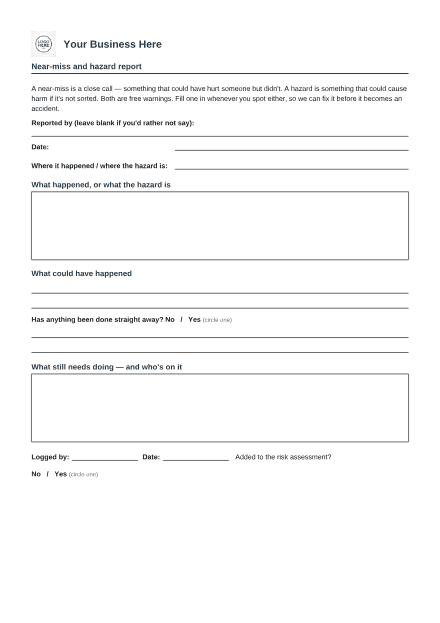
Near-miss and hazard report
Capture close calls and spotted hazards before they become accidents.
£4 inc. VAT — yours forever, no subscription.Or get it in the Safety Records pack — £29.
Type your business name and the preview updates in seconds — the real PDF, editable on screen or printable to fill in by pen. Nothing about your business leaves your browser.
What you need to know
The plain-English guidance that comes with this document.
- A near-miss is a free lesson — take it. Nobody got hurt this time, which means you get to fix the problem without anyone paying for it. The trailing cable someone tripped on but caught themselves, the box that fell off a shelf beside someone — those are exactly the warnings that stop a real accident later.
- Make it easy and blame-free to report. People only flag near-misses if they won't get grief for it. Make clear you want to hear about them, thank whoever reports one, and never use it to point fingers — the point is the hazard, not the person.
- Anonymous is fine. If someone would rather not put their name to it, let them — a reported hazard with no name is far more use than an unreported one. That's why the "reported by" line is optional.
- Close the loop — act, and be seen to act. A near-miss report that vanishes into a drawer teaches everyone it's pointless. Do the action, and let people see it was done. Feed anything that changes the picture into your risk assessment (that's the tick box at the bottom).
- Spot the patterns. One near-miss is a warning; three in the same spot is a problem shouting at you. Glance back over these now and then for anything that keeps cropping up.
- It's not a RIDDOR report — usually. Most near-misses don't need reporting to the HSE. But some specified "dangerous occurrences" do, even when no one's hurt (a scaffold collapse, for instance) — see your accident report form. If in doubt, check.
- Keep it secure. If a report names someone, it's personal data — store it with your other safety records and share it only as needed.
- Across the UK. Good near-miss reporting is sensible practice everywhere; the underlying duties to assess and control risks apply throughout Great Britain and Northern Ireland alike.
Please note: This is a template for guidance only. Adapt it to your business and check it against current law and your insurance requirements. It is not legal advice.