
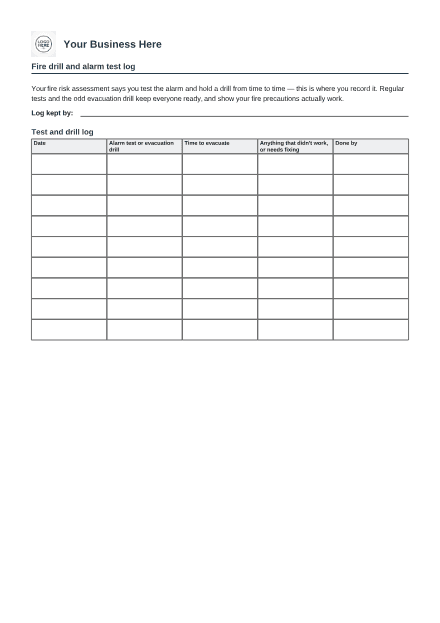
Fire drill and alarm test log
Record your alarm tests and evacuation drills — proof your precautions work.
£4 inc. VAT — yours forever, no subscription.Or get it in the Safety Records pack — £29.
Type your business name and the preview updates in seconds — the real PDF, editable on screen or printable to fill in by pen. Nothing about your business leaves your browser.
What you need to know
The plain-English guidance that comes with this document.
- This closes the loop on your fire risk assessment. That document promises you test the alarm and practise getting out — this log is the proof you actually do. Together they're exactly what a fire officer or insurer wants to see.
- Test the alarm regularly — little and often. A common routine is a short weekly test, ideally at the same time each week (so people learn it's just a test) and from a different call point each time (so you check them all over time). It only takes a moment; log it here.
- Hold a proper drill now and then. Actually walk everyone out to the assembly point — don't just talk about it. Time how long it takes, and watch for the real-world snags: a fire door that sticks, a delivery blocking an exit, someone who didn't hear the alarm or didn't know where to go.
- The point of a drill is to find the problems. Whatever went wrong is a gift — fix it. A blocked exit, a dead alarm, confusion over the plan: far better to find it in a drill than in a real fire. Note it in the log and sort it.
- Bring new starters into it. Cover the escape plan at their induction, and make sure they go through a drill early rather than meeting the alarm for the first time in an emergency.
- Keep the log. A run of dated tests and drills is solid evidence that your fire precautions are maintained and practised — and it's the kind of record that protects you if the worst ever happens.
- Scotland and Northern Ireland run their own fire law. As with your fire risk assessment, the detail differs by nation (Scotland and NI have their own fire safety regimes) — but testing your alarm and practising your escape is sensible everywhere.
Please note: This is a template for guidance only. Adapt it to your business and check it against current law and your insurance requirements. It is not legal advice.