
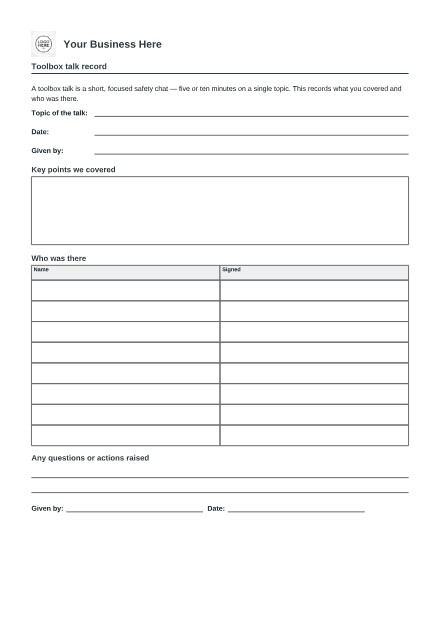
Toolbox talk record
Record short safety briefings and who attended.
£4 inc. VAT — yours forever, no subscription.Or get it in the Safety Records pack — £29.
Type your business name and the preview updates in seconds — the real PDF, editable on screen or printable to fill in by pen. Nothing about your business leaves your browser.
What you need to know
The plain-English guidance that comes with this document.
- Short and focused beats long and forgotten. A toolbox talk is a few minutes on one thing — not an hour-long lecture once a year. Pick a single topic, keep it practical, and people will actually take it in.
- Good topics are the live ones. A recent near-miss, a new bit of kit, a seasonal risk (icy paths in winter, dehydration in a hot kitchen), slips and trips, safe lifting, what to do in a fire. If something's just gone slightly wrong, that's your next talk.
- Talk with people, not at them. Ask what they've noticed, what feels awkward or risky. The people doing the job will tell you things you'd never spot from the office — and they're far more likely to act on advice they helped shape.
- Record it — it's your proof of training. Topic, date, who was there. This log shows you're actively keeping people safe, and a run of them is exactly the kind of evidence that helps if there's ever an accident or an inspection.
- Follow up on what comes up. If someone raises a hazard or a question you can't answer on the spot, note it and come back to them. An action raised and dropped teaches people not to bother next time.
- Keep them regular. A quick talk every week or two keeps safety ticking over far better than a big annual push. Little and often wins.
- Across the UK. Toolbox talks are good practice everywhere — the underlying duty to inform, instruct and train applies throughout Great Britain and Northern Ireland.
Please note: This is a template for guidance only. Adapt it to your business and check it against current law and your insurance requirements. It is not legal advice.