
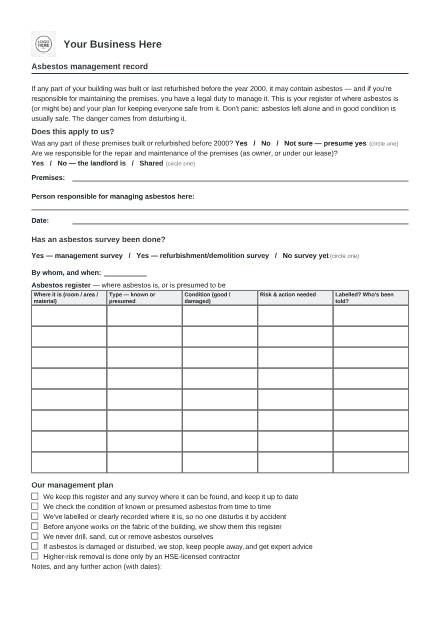
Asbestos management record
The duty-to-manage register and plan for any premises built before 2000.
£7 inc. VAT — yours forever, no subscription.Or get it in the Safety at Work pack — £34.
Type your business name and the preview updates in seconds — the real PDF, editable on screen or printable to fill in by pen. Nothing about your business leaves your browser.
What you need to know
The plain-English guidance that comes with this document.
- This is a legal duty most small businesses don't know they have. Under the Control of Asbestos Regulations 2012 (regulation 4, the "duty to manage"), whoever is responsible for maintaining non-domestic premises must find out whether asbestos is present, record where it is and what condition it's in, assess the risk, put a plan in place to manage it, and tell anyone who might disturb it. If you own or lease business premises built before 2000, that duty is almost certainly yours — check your lease for who's responsible for repairs.
- Asbestos is the UK's biggest work-related killer — and it's slow. It causes over 5,000 deaths a year, decades after exposure. Tradespeople — plumbers, electricians, joiners, builders — are among the most at risk, because they cut into ceilings, walls and floors and disturb it without knowing it's there. That's exactly why the register and "tell people before they work on the building" step matter so much.
- Left alone and in good nick, it's usually safe. Asbestos that's undamaged and won't be disturbed is generally best left in place, sealed or labelled, and monitored — not ripped out. Unnecessary removal can create more risk (and cost) than managing it. The whole point of this record is to know where it is so it stays undisturbed.
- Two kinds of survey — know which you need. A management survey finds and assesses asbestos for normal day-to-day occupation — that's what supports this register. A refurbishment and demolition survey is more intrusive and is required before any building, refurbishment or demolition work that could disturb the fabric. Never start that kind of work on a pre-2000 building without one.
- If you don't know, presume it's there. You don't have to survey the moment you read this, but until you know, treat suspect materials (old ceiling tiles, floor tiles, pipe lagging, textured coatings like Artex, cement roof sheets, boards behind boilers) as if they contain asbestos and don't touch them.
- Never DIY it — and know when it must be licensed. Don't drill, sand, break or remove suspected asbestos yourself. Higher-risk materials — sprayed coatings, lagging, insulation, and most asbestos insulating board — must only be removed by an HSE-licensed contractor. Some lower-risk work (like asbestos cement) can be non-licensed, but still needs the right training and controls. If in doubt, get a professional.
- Working on other people's buildings? The duty travels with the risk. If your trade takes you into other premises, you can't rely on the register being there. Ask the person in control for their asbestos information before you start, assume it's present in anything pre-2000, and stop work if you uncover something unexpected. Anyone who might disturb asbestos should have had asbestos awareness training — it's a legal expectation, not a nicety.
- Domestic properties have a twist. The duty to manage covers the common parts of domestic buildings (shared halls, stairwells, roof spaces of flats), not inside private homes — but if you employ people to work in domestic settings, you still have to protect them from asbestos there.
- Review it, and after any building work. Look over the register periodically to check conditions haven't changed, and update it whenever you have work done or learn something new. Keep it with your health and safety records.
- Applies UK-wide. The Control of Asbestos Regulations 2012 apply across Great Britain (HSE); Northern Ireland has equivalent regulations (HSENI). The duty and the approach are the same.
Please note: This is a template for guidance only. Adapt it to your business and check it against current law and your insurance requirements. It is not legal advice.