
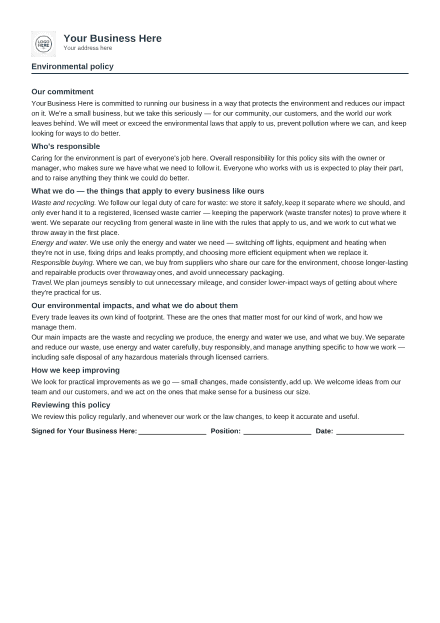
Environmental policy
A tender-ready environmental policy, tailored to your trade.
£7 inc. VAT — yours forever, no subscription.Or get it in the Safety at Work pack — £34.
Type your business name and the preview updates in seconds — the real PDF, editable on screen or printable to fill in by pen. Nothing about your business leaves your browser.
What you need to know
The plain-English guidance that comes with this document.
- This is the tailored one — the right trade content is already in it. When you set your business type at setup, this policy fills its "our impacts" section with the content that fits your trade. You should still read it and tweak anything that isn't quite you — it's a strong, credible starting point, not a straitjacket. If your work spans more than one trade, add the extra impacts by hand.
- It's mainly a door-opener for work. A written environmental policy is often asked for in tenders and on supplier questionnaires, especially for medium and larger contracts and anything public-sector. Having a genuine, professionally structured one ready can be the difference between making a shortlist and being filtered out. It's rarely a strict legal requirement for a small business, but it's frequently a commercial one.
- The recycling rules changed — and this policy reflects them. In England, "Simpler Recycling" means workplaces with 10 or more employees have had to separate dry recycling (glass, metal, plastic, card and paper) and food waste from general waste since 31 March 2025; businesses with fewer than 10 employees must do the same from 31 March 2027. So even the smallest firms should be getting ready now. Wales already requires all workplaces to separate recyclables (since April 2024) and its rules are stricter; Scotland and Northern Ireland run their own schemes. Check what applies where you are.
- Your waste is your legal responsibility — the "duty of care". Any business producing waste has a legal duty of care: store it safely, and only pass it to a registered waste carrier, keeping the waste transfer notes. Fly-tipping by a dodgy "man with a van" you paid can come back to you if you didn't check they were licensed — you can check a carrier's registration on the environmental regulator's website. Hazardous wastes (oils, chemicals, asbestos, batteries, electricals) have extra rules.
- Only promise what you'll actually do. The value of this policy is that it's honest and specific to your trade. Don't bolt on grand claims about carbon-neutrality or certifications you don't hold — an inflated policy that falls apart under a client's questions does more harm than a modest, truthful one. If you don't yet do something in here, either start doing it or take it out.
- Sign, date and review it. A policy with a name, a date and a signature reads as real; an undated one reads as filler. Review it when your work changes or the rules move, and keep the signed copy handy for when a tender asks for it.
- Applies UK-wide, with real regional differences here. Environmental law is devolved, so waste and recycling duties genuinely differ across England, Wales, Scotland and Northern Ireland — more so than most employment law. The commitments in this policy hold everywhere; check your nation's specific recycling and waste rules before relying on the detail.
Please note: This is a template for guidance only. Adapt it to your business and check it against current law and your insurance requirements. It is not legal advice.