
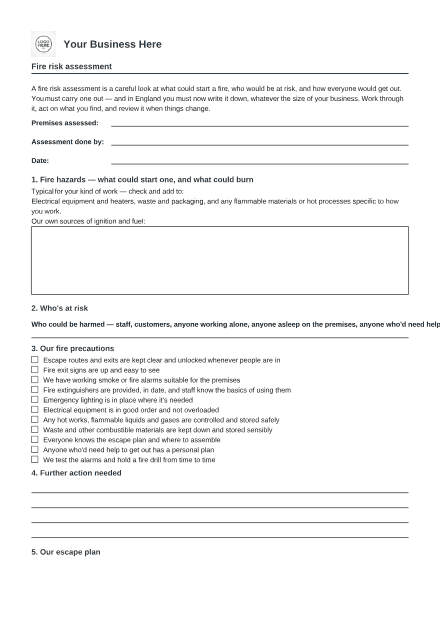
Fire risk assessment
The written fire risk assessment England now requires, with hazards tailored to your trade.
£14 inc. VAT — yours forever, no subscription.Or get it in the Safety at Work pack — £34.
Type your business name and the preview updates in seconds — the real PDF, editable on screen or printable to fill in by pen. Nothing about your business leaves your browser.
What you need to know
The plain-English guidance that comes with this document.
- You must do one — this isn't optional. Whoever's in control of the premises (usually you) is the "responsible person" and must carry out a fire risk assessment. It's a legal duty, separate from your general risk assessment, and it's the one small businesses most often forget.
- Since October 2023 in England, you must write it down — whatever your size. The old rule that only businesses with five or more employees had to record their fire risk assessment is gone. Now every responsible person in England must record it in full. So even a two-person café needs a written fire risk assessment on file — this is it.
- The trade starter points you at your real risks. The "typical fire hazards" list is filled in for your kind of work — a kitchen's fat fires and grease ducts, a roofer's torch-on work, a care home's sleeping residents. Check it against your premises and add your own. Then think in three parts: ignition, fuel, air — take away or cut down any of the three and you cut the risk.
- Clear escape routes save lives — this is the big one. A propped-open fire door, a fire exit blocked by deliveries, a locked back door during opening hours — these are what turn a small fire into a tragedy. Keep routes clear and exits openable, every single day.
- Sleeping and less-mobile people change everything. If anyone sleeps on the premises (a B&B, a care home, a flat over the shop) or would need help to get out, the risk is far higher and the escape plan has to account for them — including a personal evacuation plan for anyone who needs one. Don't treat these premises like a daytime shop.
- Hot works are a top cause of fires — control them. Cutting, grinding, welding, torch-on roofing and soldering start fires that flare up after the work's finished. If your trade does hot works, use a permit system, clear the area of anything flammable, keep an extinguisher to hand, and keep watch for a good while afterwards.
- Kit only helps if it works. Alarms tested, extinguishers the right type and in date (a water extinguisher on a fat fire makes it worse), emergency lighting where it's needed. Having them isn't enough — maintain them, and make sure people know the basics.
- Everyone needs to know the plan, and review it on change. Walk new starters through the escape plan at induction and run a drill now and then. Reassess after any change of layout, equipment or use — and after any fire or near-miss — otherwise at least once a year.
- Scotland and Northern Ireland have their own fire law. Fire safety is devolved, so the rules differ by nation. Scotland works under the Fire (Scotland) Act 2005 and the Fire Safety (Scotland) Regulations 2006; Northern Ireland under the Fire and Rescue Services (NI) Order 2006 and the Fire Safety Regulations (NI) 2010. The idea — assess, act, record, review — is the same, but the detail (including the October 2023 English recording change) is set separately, so check your nation's rules. Your local Fire and Rescue Service can help if you're unsure.
Please note: This is a template for guidance only. Adapt it to your business and check it against current law and your insurance requirements. It is not legal advice.