
Risk assessment
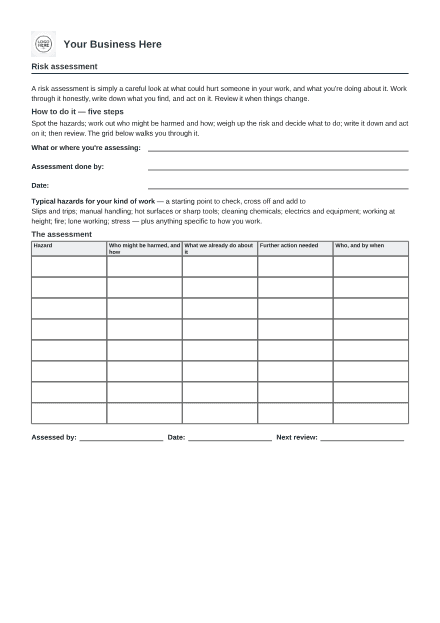
The core five-step assessment, with typical hazards pre-filled for your trade.
£7 inc. VAT — yours forever, no subscription.Or get it in the Safety at Work pack — £34.
Type your business name and the preview updates in seconds — the real PDF, editable on screen or printable to fill in by pen. Nothing about your business leaves your browser.
What you need to know
The plain-English guidance that comes with this document.
- The law expects you to do this. The Management of Health and Safety at Work Regulations require you to assess the risks in your work. If you've five or more employees you must write down the significant findings — this form is that record. Under five, you still have to assess; writing it down is just good sense.
- The trade starter does the hard part. The "typical hazards" list is filled in for your kind of business, so you're not staring at a blank page. Tick off what fits, cross out what doesn't, and add anything specific to how you work. Then write each real hazard into the grid and deal with it.
- It's five simple steps. Spot the hazards; work out who might be harmed and how; weigh up the risk and decide what to do; write it down and act on it; then review. The columns walk you through them.
- The last two columns are your action plan. "Further action" and "who, and by when" turn the assessment into a to-do list. An assessment that spots a hazard and then does nothing is worse than none — it proves you knew. Do the actions, and tick them off.
- Some risks need their own closer look — here's the quick guide. This is your overall picture; certain things get a dedicated assessment on top: - Cleaning products, oils, solvents or other substances → COSHH assessment - Heavy or awkward lifting and carrying → manual handling assessment - Screen and desk work → DSE assessment - Power tools or machinery that vibrate the hands (over about two hours a day) → hand-arm vibration assessment - An employee tells you she's pregnant, has had a baby in the last six months, or is breastfeeding → new & expectant mothers assessment - You're taking on anyone under 18 → young persons assessment - People who work alone → lone working assessment - Fire → your fire risk assessment (separate fire-safety law)
- Be proportionate, and ask your staff. A café's assessment shouldn't look like a chemical plant's. Focus on what could genuinely hurt someone — and a ten-minute chat with the people doing the job finds more real hazards than an hour at a desk.
- Review when things change — new equipment, new premises, a change in the work, or after an accident — and otherwise at least once a year. Keep it with your health and safety policy.
- Across the UK. The duty to assess is the same in England, Wales and Scotland (HSE) and in Northern Ireland (HSENI). Fire risk is assessed separately, under fire-safety law that differs by nation.
Please note: This is a template for guidance only. Adapt it to your business and check it against current law and your insurance requirements. It is not legal advice.