
Health and safety policy
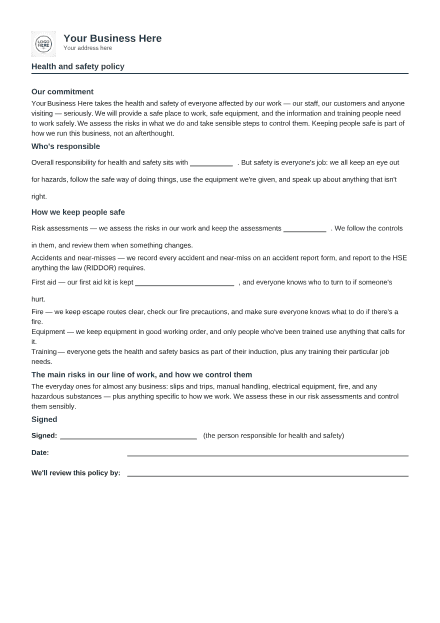
Your safety commitment and controls, with the main risks tailored to your trade.
£14 inc. VAT — yours forever, no subscription.Or get it in the Safety at Work pack — £34.
Type your business name and the preview updates in seconds — the real PDF, editable on screen or printable to fill in by pen. Nothing about your business leaves your browser.
What you need to know
The plain-English guidance that comes with this document.
- Once you've got five or more staff, this has to be in writing. With five or more employees the law requires a written health and safety policy that you bring to your team's attention. Below five it isn't compulsory — but having one is good practice, a genuine trust signal to staff and customers, and often asked for when you tender for work.
- The trade section is tailored to you — but check it against your actual work. The "main risks in our line of work" part is filled with the hazards typical of your trade. Read it properly: add anything specific to how you work, and remove anything that genuinely doesn't apply. A policy that lists risks you don't have — or misses ones you do — reads as generic, which is exactly what a good client is watching for.
- A policy has three parts — and this has all three. A good policy says what you're committed to, who's responsible, and how you actually do it. Miss one and it's only half a policy.
- It has to match reality. The fastest way to make a policy worthless is to promise things you don't do. If it says escape routes are kept clear, they need to actually be clear. Write down what you genuinely do, then live up to it.
- Higher-risk trades: get a competent person to check it. If you're in construction, roofing, on vehicles, in care, or doing gas, electrical or work-at-height, your risks carry real legal weight — and the law expects you to draw on competent health-and-safety advice. Treat this policy as a strong, professionally structured starting point, and have someone competent review it for your specific work before you rely on it. It points to your risk assessments, which are where the detail lives.
- Put it where people can see it, and cover it at induction. A policy in a drawer protects no one. Display it or hand it out, and walk new starters through it as part of their health & safety induction.
- Landlords are a different case. A "landlord health and safety policy" is really about the safety of a rented property — gas safety certificates, electrical checks (EICR), fire safety and HMO rules — not about employing people. If that's what you need, it's a separate kind of document; this one is an employer's policy.
- Make sure everyone actually understands it. If some of your team don't read English easily, explaining the policy in a way they understand isn't a nicety — it's part of your duty to communicate risks. Go through it in person, use your risk assessments' plain descriptions, and don't rely on the written page alone.
- Review it when things change — and date it. New equipment, new premises, a new kind of work, or just once a year: give it a look, and put the review date on it.
- Across the UK. The core duty is the same in England, Wales and Scotland under the Health and Safety at Work Act (enforced by the HSE). Northern Ireland has its own equivalent — the Health and Safety at Work (Northern Ireland) Order — enforced by HSENI, to the same effect. (Fire safety is a separate matter and differs by nation — see your fire risk assessment.)
Please note: This is a template for guidance only. Adapt it to your business and check it against current law and your insurance requirements. It is not legal advice.