
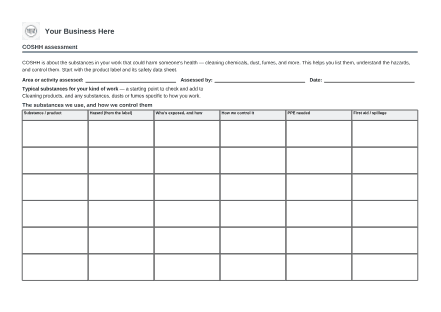
COSHH assessment
Assess hazardous substances, with the typical ones pre-filled for your trade.
£7 inc. VAT — yours forever, no subscription.Or get it in the Safety at Work pack — £34.
Type your business name and the preview updates in seconds — the real PDF, editable on screen or printable to fill in by pen. Nothing about your business leaves your browser.
What you need to know
The plain-English guidance that comes with this document.
- The law expects you to control the nasties. The COSHH Regulations require you to assess substances that could harm health and control exposure to them. For most small businesses that means cleaning products — but as the trade list on your form shows, it can also mean wood dust, salon chemicals, silica or welding fume. This is your record of having thought it through.
- The trade starter gets you going — but it's not the finished job. The "typical substances" list is filled in for your kind of work so you're not staring at a blank grid. Check it against what you actually use, add anything missing, then work each real substance through the grid. Your own products are what matter.
- Start with the label and the safety data sheet. Every hazardous product has a label (those orange-and-white warning symbols) and the supplier must give you a safety data sheet if you ask. Between them they tell you the hazards, the right PPE, how to store it and what to do in a spill — most of what fills the grid.
- PPE is the last resort, not the first. The safest move is to not use the hazardous stuff at all, or swap it for something milder. Then control it — dilute, ventilate, keep lids on, extract dust at source. Gloves and masks come last, to mop up what's left, not as the whole answer.
- Never mix products — this is the one that lands people in hospital. Bleach mixed with an acidic or ammonia-based cleaner gives off chlorine gas. It's a genuinely dangerous, and genuinely common, mistake. Make it a firm rule and tell every new starter.
- Some substances need health surveillance. Wood dust, isocyanate paints, certain salon chemicals, silica and some others can cause asthma, dermatitis or worse, and may require health checks for people regularly exposed. Higher-risk trades should take this seriously — check the HSE's guidance for your substances.
- Dust and fume count too — it's not just liquids in bottles. Flour dust, wood dust, silica from cutting, welding and solder fume are all COSHH substances, and often the more damaging ones because the harm builds up unseen. Control them at source with extraction, not just masks.
- Tell and train your staff, and review on change. People need to know what they're handling, the risks and the controls. Take another look when a product, process or supplier changes — otherwise at least once a year.
- Across the UK. COSHH applies in England, Wales and Scotland; Northern Ireland has its own equivalent regulations to the same effect. The HSE's free "COSHH essentials" guidance is a good starting point wherever you are.
Please note: This is a template for guidance only. Adapt it to your business and check it against current law and your insurance requirements. It is not legal advice.