
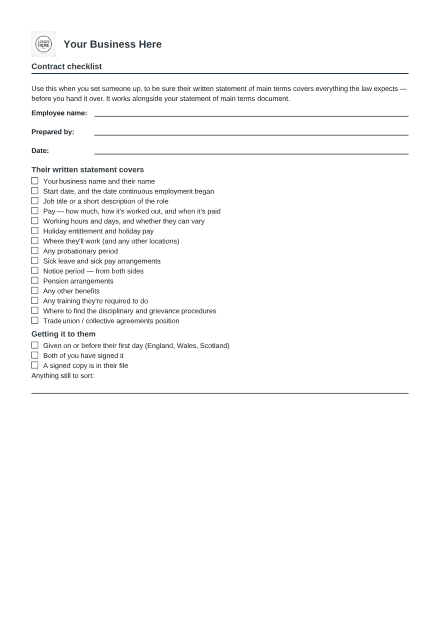
Contract checklist
The pre-flight check that your written statement covers everything.
£7 inc. VAT — yours forever, no subscription.Or get it in the HR Essentials pack — £39.
Type your business name and the preview updates in seconds — the real PDF, editable on screen or printable to fill in by pen. Nothing about your business leaves your browser.
What you need to know
The plain-English guidance that comes with this document.
- This is the pre-flight check for the big one. The written statement of main terms is a legal must-have from day one, and it has to cover a set list of things. Miss one and you're technically in breach — and it looks sloppy if it ever comes up. Run down this list before you hand the statement over, and you'll know it's complete.
- Use it with the statement of main terms document. This checklist just confirms the boxes are ticked; the statement of main terms document is where you actually write it all. Keep them together.
- Day one in Great Britain — two months in Northern Ireland. In England, Wales and Scotland the statement must be given on or before the first day. Northern Ireland allows up to two months and has a slightly narrower required list — the statement's own guidance covers this.
- Get it signed, and keep the copy. The statement isn't the whole contract, but it's strong evidence of what was agreed. Both of you sign, and the signed copy goes in their file (your staff file checklist has a line for it).
- A quick word on the extras. A few items — pension details, training entitlement, the disciplinary and grievance procedures — can legally be pointed to in another document (like your handbook) rather than spelled out in full on the statement. That's fine, as long as the statement clearly says where to find them.
- Same core rules across Great Britain; check NI. England, Wales and Scotland share the same day-one written-statement rules. Northern Ireland runs to its own timing and list, so if you're there, follow the NI position.
Please note: This is a template for guidance only. Adapt it to your business and check it against current law and your insurance requirements. It is not legal advice.