First aid needs and kit checklist
Work out what first aid you need, and keep the kit stocked.
£7 inc. VAT — yours forever, no subscription.Or get it in the Safety at Work pack — £34.
Type your business name and the preview updates in seconds — the real PDF, editable on screen or printable to fill in by pen. Nothing about your business leaves your browser.
What you need to know
The plain-English guidance that comes with this document.
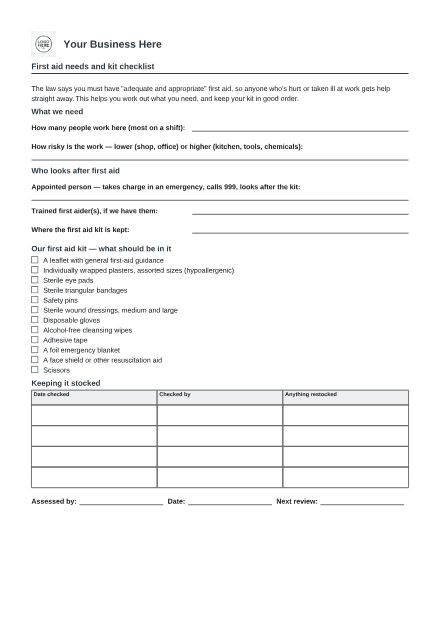
- The test is "adequate and appropriate" — so start with a needs check. The First-Aid Regulations don't hand you a fixed shopping list; they ask you to provide what's sensible for your risks and how many people are about. A quiet shop and a busy kitchen need different things — that's what the top of this form is for.
- The bare minimum: a stocked kit and an "appointed person". Every workplace needs a properly stocked first aid kit and someone put in charge of first aid arrangements — the "appointed person" who takes charge in an emergency, calls 999, and keeps the kit topped up. They don't need formal training to do that role.
- Higher-risk work usually needs a trained first aider. If you've got a kitchen, power tools, chemicals or the like, seriously consider a properly trained first aider (the one-day EFAW or three-day FAW course). First-aid certificates last three years, so diary the refresher.
- No tablets or medicines in a workplace kit. A first aid kit shouldn't contain paracetamol, aspirin or any other medication — that's not what workplace first aid is for, and it invites trouble. Keep it to dressings and the basics.
- An empty kit is no kit — so check it. Give someone the job of checking and restocking, and log it (that's the little table). It's the sort of thing that quietly runs down until the day you actually need it.
- Make sure people know. Everyone should know where the kit is and who the first aider or appointed person is — cover it at induction and note it in your health and safety policy.
- Think about mental health too. First aid isn't only cuts and burns. Knowing how to spot when someone's struggling, and where to point them, is increasingly part of looking after your team — worth considering even if it's not strictly required.
- On the road? Carry a kit. If your work is mobile — a plumber, a mobile hairdresser — keep a kit in the van as well as at base.
- Across the UK. The duty to provide first aid is the same throughout — Great Britain under the Health and Safety (First-Aid) Regulations 1981, and Northern Ireland under its own equivalent 1982 regulations, to the same effect.
Please note: This is a template for guidance only. Adapt it to your business and check it against current law and your insurance requirements. It is not legal advice.