
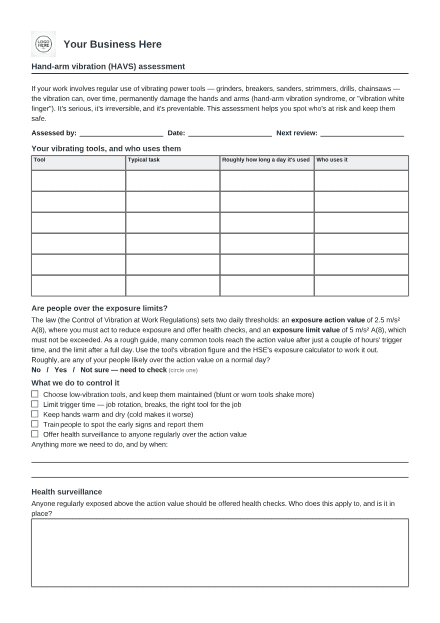
Hand-arm vibration (HAVS) assessment
For regular power-tool users — spot who's at risk before the damage is done.
£7 inc. VAT — yours forever, no subscription.Or get it in the Safety at Work pack — £34.
Type your business name and the preview updates in seconds — the real PDF, editable on screen or printable to fill in by pen. Nothing about your business leaves your browser.
What you need to know
The plain-English guidance that comes with this document.
- The damage is permanent — that's why this matters. Hand-arm vibration syndrome causes numb, tingling, blanched fingers, loss of grip and dexterity, and pain — and once it's done, it doesn't come back. Carpal tunnel syndrome is linked too. It builds up quietly over years, so the time to act is long before anyone complains.
- Two numbers to know. The exposure action value is 2.5 m/s² A(8) — hit that and you must reduce exposure and offer health surveillance. The exposure limit value is 5 m/s² A(8) — you must not exceed it. The "A(8)" means averaged over a working day, so it's about the vibration level of the tool and how long it's used together. The HSE's free online exposure calculator does the sums for you.
- Trigger time is shorter than people think. It's not how long the job takes, it's how long the tool is actually running in the hand. A powerful breaker or grinder can reach the action value in well under an hour. Don't assume "it's only now and then" means you're fine — check.
- Control the exposure, not just the paperwork. The real fixes are lower-vibration tools, sharp and well-maintained kit, job rotation to share out trigger time, warm dry hands, and not using a big aggressive tool where a smaller one would do. PPE "anti-vibration gloves" are not a reliable control and shouldn't be relied on.
- Health surveillance is a legal duty above the action value. If people are regularly over the action value you must offer health checks to catch early signs — usually a simple questionnaire to start, escalating if needed. It protects them and protects you.
- Applies UK-wide. The Control of Vibration at Work Regulations apply across Great Britain (HSE); Northern Ireland has equivalent rules (HSENI). Pair this with your noise controls — the same tools are often loud, too.
Please note: This is a template for guidance only. Adapt it to your business and check it against current law and your insurance requirements. It is not legal advice.