
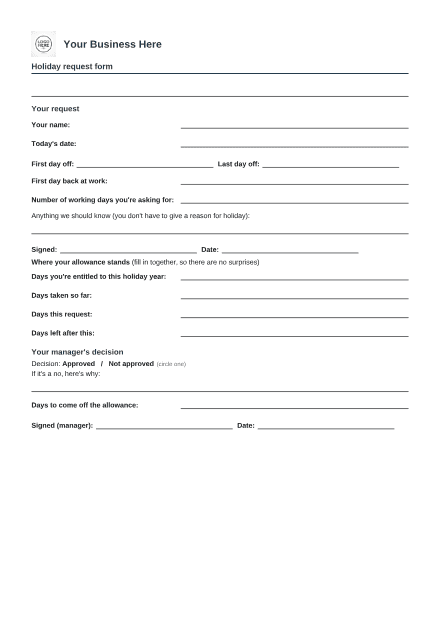
Holiday request form
Ask for time off, and keep the running allowance tally straight.
£4 inc. VAT — yours forever, no subscription.Or get it in the HR Essentials pack — £39.
Type your business name and the preview updates in seconds — the real PDF, editable on screen or printable to fill in by pen. Nothing about your business leaves your browser.
What you need to know
The plain-English guidance that comes with this document.
- Why this comes as a blank form. BossKit brands it with your business and leaves every staff detail as a line to fill in by hand — we never ask for, or hold, anything about your people. Print a stack, keep them by the till or in the office, and fill one in each time someone asks for time off.
- The intro at the top is yours to reword. It prints with sensible wording that works as-is, but you can rewrite it in the Builder to spell out your own notice rule, your holiday year, and any busy spells you can't cover. One caution: whatever you promise there, you have to live with — don't write "we always say yes" unless you mean it.
- How much notice they owe you. The legal default is that someone gives notice of at least twice the length of the leave they want — so two days' notice for a day off, two weeks for a week. You can set your own rule and say so in the intro, but put it in writing and apply it to everyone the same way.
- You can say no — but there's a right way. You don't need a cast-iron "business reason" to turn a request down, but if you do, you must give counter-notice at least as long as the leave they asked for (so, to refuse a week, you tell them at least a week before it would've started). Never refuse in a way that singles someone out or that stops them taking their 5.6 weeks by year-end.
- You can also tell people when to take it. Shutting for a fortnight at Christmas, or a quiet week in January? You're allowed to require staff to take leave then, as long as you give notice of at least twice the length — a week off needs two weeks' warning. Flag any such periods in the intro so nobody's caught out.
- Unpaid leave and "other" are your call. There's no general right to unpaid leave (time off for dependants in an emergency is the main exception), so treat those requests on their merits — and consistently. The "type of leave" line just makes sure a day of unpaid leave isn't quietly deducted from someone's holiday allowance, or vice versa.
- Bank holidays: be consistent with the statement of main terms. Whether bank holidays come out of someone's allowance depends on what their written terms say. Whatever you set there, match it here — mixing the two is where arguments start.
- Keep the running tally honest. The "where your allowance stands" box isn't decoration. If you lose track and over-grant, you can end up paying out a chunk of untaken holiday when someone leaves — every day owed is a day's pay. Update it every time you approve a request.
- Part-time and irregular hours work differently. Part-timers get the same 5.6 weeks, just pro rata — a three-day-a-week person gets 16.8 days. For staff on irregular or term-time hours, holiday is worked out on a different basis; check the current method on gov.uk before you write numbers down.
- Same entitlement across the UK. The 5.6 weeks and these request rules apply in England, Wales and Scotland alike. Northern Ireland runs under its own Working Time Regulations, but the entitlement is the same — so this form works UK-wide.
- A rejected request still has their name on it. Once completed, this form holds personal data, approved or not. File it in that person's records and keep it secure — don't leave it face-up on the counter.
Please note: This is a template for guidance only. Adapt it to your business and check it against current law and your insurance requirements. It is not legal advice.