
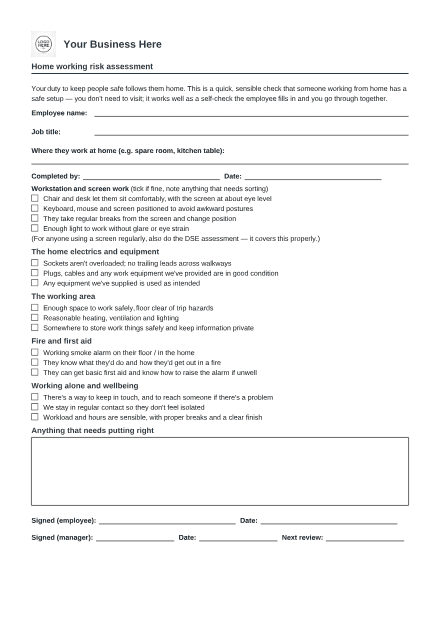
Home working risk assessment
A self-check that a home setup is safe — your duty follows them home.
£7 inc. VAT — yours forever, no subscription.Or get it in the Safety at Work pack — £34.
Type your business name and the preview updates in seconds — the real PDF, editable on screen or printable to fill in by pen. Nothing about your business leaves your browser.
What you need to know
The plain-English guidance that comes with this document.
- Your duty doesn't stop at the front door. The Health and Safety at Work Act and the Management Regulations apply to home workers just as they do in your own premises. You can't inspect someone's spare room the way you would a shop floor, but you're still expected to assess the risks and do what's reasonable — a self-check like this is exactly what's expected of a small employer.
- Screen work is the main one — link it to DSE. For most home workers the real risk is poor posture at a made-do desk. This form flags it; your DSE assessment covers it in full. Between them you've got the workstation properly covered, and you can help with simple, cheap fixes (a laptop stand, a separate keyboard, a cushion).
- You don't have to rewire their house. You're responsible for the equipment you provide and for giving sensible guidance — not for the safety of their whole home. Ask them to flag obvious problems (scorched sockets, dodgy leads), point them at simple fixes, and record it.
- Isolation and hours are real risks, not soft ones. Home workers can drift into long hours, skipped breaks and loneliness. Keeping in regular touch, respecting finishing times, and making it normal to speak up are genuine health-and-safety measures, not just nice-to-haves.
- Do it once properly, and review on change. One assessment per home worker is fine until something changes — a house move, a new health issue, a change in what they do, or going from occasional to regular home working. Then take another look.
- Applies UK-wide. The duties are the same across Great Britain (HSE) and Northern Ireland (HSENI). The approach — assess, help, record, review — holds wherever they are.
Please note: This is a template for guidance only. Adapt it to your business and check it against current law and your insurance requirements. It is not legal advice.