
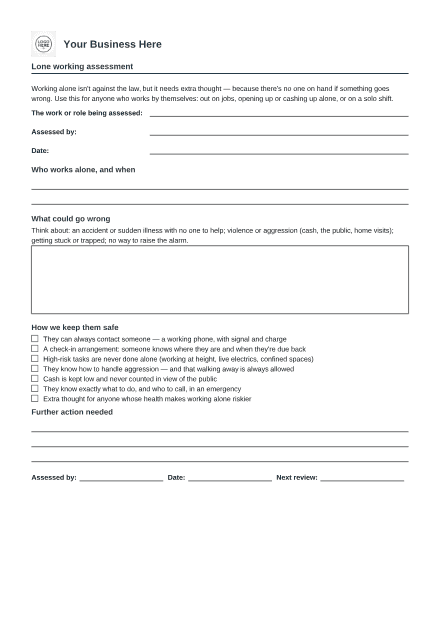
Lone working assessment
For anyone opening up, closing up, or working on their own.
£7 inc. VAT — yours forever, no subscription.Or get it in the Safety at Work pack — £34.
Type your business name and the preview updates in seconds — the real PDF, editable on screen or printable to fill in by pen. Nothing about your business leaves your browser.
What you need to know
The plain-English guidance that comes with this document.
- Alone is allowed — leaving them to it isn't. There's no law against working alone, but you still have to think through the risks and put sensible protections in place. "They'll be fine" is not a plan.
- Two risks dominate: no help, and other people. If a lone worker has an accident or falls ill, there's no one to help or raise the alarm — so being able to call for help matters enormously. And for anyone dealing with the public, cash, or visiting people's homes, the risk of aggression or violence is real and needs planning for.
- A check-in system is the single best control. Someone should know where a lone worker is and when they're due to finish, with a plan for what happens if they don't check in. It's simple, cheap, and it's what turns "no one knew" into "we raised the alarm within the hour".
- Some jobs must never be done alone. Working at height, in confined spaces, or on live electrics can be off-limits for a lone worker — the risk is too high without someone there. Draw those lines clearly and stick to them.
- Take the violence risk seriously. For public-facing or home-visit work, train people to read a situation, de-escalate, and — above all — leave. Make clear that walking away from an aggressive customer is exactly what you want them to do, never something they'll be in trouble for. And listen when they report a bad encounter.
- Factor in health, sensitively. A condition like epilepsy or a heart problem can make working alone riskier. Handle it privately and supportively, but do factor it in rather than ignore it.
- For higher risk, consider a lone-worker device. Apps and devices that let someone raise an alarm (or trigger one automatically if they don't respond) are worth it where the risk is significant.
- Review after any incident, or when the work changes. A scare, a new type of job, a new site — take another look. Otherwise, at least once a year.
- Across the UK. The duty to assess and control lone-working risks applies throughout Great Britain and Northern Ireland alike.
Please note: This is a template for guidance only. Adapt it to your business and check it against current law and your insurance requirements. It is not legal advice.