
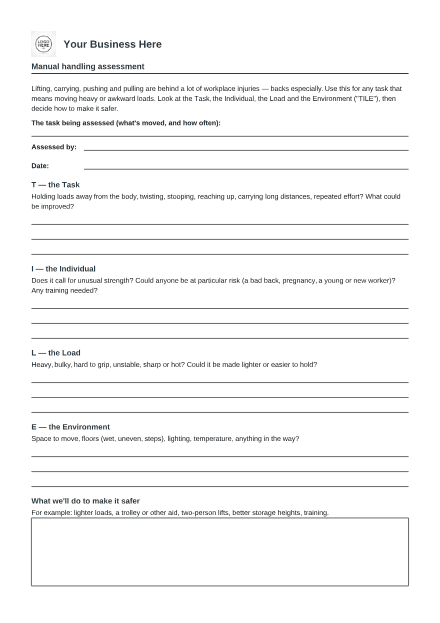
Manual handling assessment
Assess lifting and carrying with the TILE approach.
£7 inc. VAT — yours forever, no subscription.Or get it in the Safety at Work pack — £34.
Type your business name and the preview updates in seconds — the real PDF, editable on screen or printable to fill in by pen. Nothing about your business leaves your browser.
What you need to know
The plain-English guidance that comes with this document.
- Avoid the risky lift first — then reduce what's left. The Manual Handling Regulations ask you to avoid hazardous manual handling where you reasonably can, and where you can't, to assess it and cut the risk. So the first question is always "do we even need to move this by hand?" — can it be delivered to where it's used, or split into smaller loads?
- TILE is the memory jog. Task (what the movement involves), Individual (who's doing it), Load (what's being moved), Environment (where). Work through all four and you won't miss much — that's what the sections here are.
- There's no legal "safe weight" — don't treat the guide figures as a licence. The HSE's guideline weights (roughly 25kg for a man lifting close to the body at waist height, less for women, and much less once you're reaching or twisting) are a rough screening tool, not a limit that makes anything below it automatically fine. Awkward, repeated or twisted lifts can hurt someone well under any number.
- Aids beat willpower. A trolley, a sack truck, storing heavy things between knee and shoulder height, or simply a two-person lift will do more than any amount of "lift with your legs". Reducing the load is the real fix; good technique is the finishing touch.
- Some people are more at risk — factor that in. Pregnancy, an existing back problem, and young or brand-new workers all deserve extra thought. Don't hand the heaviest job to the person least able to do it safely.
- Train people, but don't rely on training alone. Showing someone how to lift well is worth doing — just don't let it become the whole answer while the loads stay too heavy.
- Review after any injury, or when the task changes. A tweaked back, a new delivery arrangement, a heavier product — any of those means another look. Otherwise, at least once a year.
- Across the UK. The manual handling rules apply in England, Wales and Scotland, with an equivalent in Northern Ireland — same approach throughout.
Please note: This is a template for guidance only. Adapt it to your business and check it against current law and your insurance requirements. It is not legal advice.