
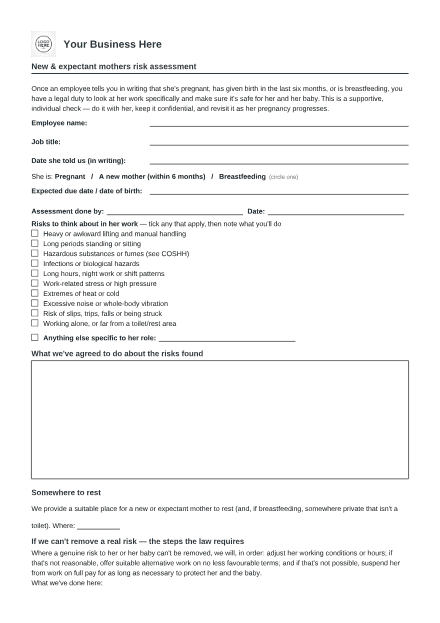
New and expectant mothers risk assessment
The individual check the law requires once an employee tells you she's pregnant.
£7 inc. VAT — yours forever, no subscription.Or get it in the Safety at Work pack — £34.
Type your business name and the preview updates in seconds — the real PDF, editable on screen or printable to fill in by pen. Nothing about your business leaves your browser.
What you need to know
The plain-English guidance that comes with this document.
- This is a specific legal duty — and it's triggered by her telling you. The Management of Health and Safety at Work Regulations require an individual risk assessment once an employee notifies you in writing that she's pregnant, has given birth within the last six months, or is breastfeeding. Your general risk assessment isn't enough on its own — this has to look at her work, her risks. Ignoring it is both unsafe and pregnancy discrimination waiting to happen.
- Do it with her, and keep it private. She knows how she's feeling and what parts of the job are getting harder. Talk it through together, agree the changes, and treat everything as confidential health information — stored securely, shared only with those who need to know.
- Know the three steps if a risk can't be removed. If you can't control a genuine risk any other way, the law sets a strict order: first adjust her hours or conditions; if that won't work, offer suitable alternative work on the same terms; and only if neither is possible, suspend her on full pay (this is medical suspension, not sick leave, and it's fully paid). Don't jump to "there's nothing we can do" — the steps exist precisely to keep her working safely.
- Common risks for a small business. Heavy lifting, long spells on her feet, certain cleaning chemicals or substances, infection risk, night shifts and long hours, stress, and extreme temperatures are the usual ones. Fatigue and morning sickness also matter — small adjustments to breaks and duties go a long way.
- Rest facilities aren't optional. You must provide somewhere for a new or expectant mother to rest. If she's breastfeeding on return, provide a private space that is not a toilet (the law expects somewhere suitable) and, ideally, somewhere to store milk.
- Review as it goes. Risks change across a pregnancy and again after the birth. Diary a review, and redo it if her role, her health or the advice changes.
- She's protected from day one, and beyond. Pregnancy and maternity are protected under the Equality Act from the start of employment, and redundancy protection now extends well beyond maternity leave. Handle absences, adjustments and decisions with that in mind — and take advice before any difficult decision involving a pregnant employee or new mother.
- Applies UK-wide. The assessment duty applies across Great Britain (HSE) and Northern Ireland (HSENI). The employment protections apply UK-wide, though some detail differs in NI.
Please note: This is a template for guidance only. Adapt it to your business and check it against current law and your insurance requirements. It is not legal advice.