Sickness absence policy
What to do when you're off sick — written to the April 2026 SSP rules.
£7 inc. VAT — yours forever, no subscription.Or get it in the HR Essentials pack — £39.
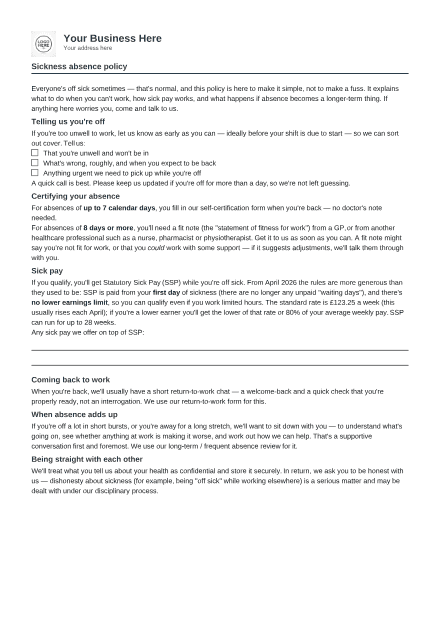
Type your business name and the preview updates in seconds — the real PDF, editable on screen or printable to fill in by pen. Nothing about your business leaves your browser.
What you need to know
The plain-English guidance that comes with this document.
- The SSP rules changed a lot in April 2026 — make sure your policy reflects it. The old three unpaid "waiting days" are gone, so SSP is now due from day one of sickness. The lower earnings limit has also been removed, so employees who earn too little used to miss out and now qualify (getting the lower of the flat rate or 80% of their pay). If you're using an old sick-pay policy from before April 2026, it's almost certainly wrong now — this one is written to the current rules.
- You can't reclaim SSP anymore — budget for it. Unlike the family-leave payments, employers generally can't recover SSP from the government. It's a real cost, so factor it into your planning, especially now it's paid from day one.
- Self-cert for a week, fit note after that. Employees can self-certify the first 7 calendar days (not working days — the count includes weekends). Only from the 8th day do they need a fit note. Don't demand a doctor's note for a two-day cold; you can't insist on one for the first week, and GPs won't thank you for it.
- A fit note isn't a straight yes/no. Modern fit notes often say someone "may be fit for work" with support — a phased return, lighter duties, different hours. Treat that as the start of a conversation, not a box to tick. Ignoring sensible suggested adjustments is where employers get into trouble.
- Watch the line between capability and disability. Persistent or long-term ill health may amount to a disability under the Equality Act 2010, which means you have a legal duty to consider reasonable adjustments and must not dismiss or discriminate because of it. Manage genuine ill-health absence as a capability matter with care and medical input — never as misconduct. Only outright dishonesty (pulling a sickie, working elsewhere while "off") belongs in the disciplinary process.
- Trigger points help, but don't apply them like a robot. Some employers use a threshold — say, a return-to-work chat after every absence and a review after a set number of separate absences in a rolling year. That's fine as a prompt to look, but always look at the reason: absences linked to a disability or to pregnancy should usually be treated separately, not counted towards a trigger.
- Keep health information locked down. Sickness details are special-category personal data under UK GDPR. Store them securely, share them only with those who genuinely need to know, and keep them out of general staff files that others can see.
- Applies UK-wide, with the usual NI caveat. SSP and the Equality Act framework apply across Great Britain; Northern Ireland has its own, closely-matching equality law and follows the SSP scheme. Where a specific reform lands differently in NI, check the current position.
Please note: This is a template for guidance only. Adapt it to your business and check it against current law and your insurance requirements. It is not legal advice.