
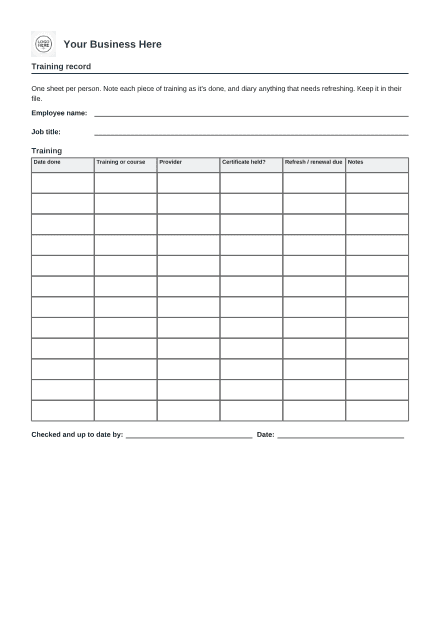
Training record
Track who's been trained on what, and when it's due again.
£4 inc. VAT — yours forever, no subscription.Or get it in the HR Essentials pack — £39.
Type your business name and the preview updates in seconds — the real PDF, editable on screen or printable to fill in by pen. Nothing about your business leaves your browser.
What you need to know
The plain-English guidance that comes with this document.
- This is your proof that people are trained. For a lot of small businesses some training isn't optional — food hygiene in a kitchen, first aid, manual handling, licensing. If anyone ever asks "can this person do this safely and legally?", a clear record with dates and certificates answers it on the spot.
- Diary the refreshers — that's the bit people forget. Training isn't done once and forgotten. First-aid certificates typically last three years, and food hygiene is usually refreshed every few years as good practice. Put the renewal date in the "refresh due" column and actually diary it, so a certificate doesn't quietly lapse.
- Keep the certificates with this. The record says it happened; the certificate proves it. File them together.
- Required training is on your time and your money. If training is genuinely required for the role, you should pay for it and give paid time to do it — that ties back to what you've put on their statement of main terms. Don't dock someone for training you've told them to complete.
- Start on day one. Health-and-safety basics and any role-critical training (like food hygiene before handling food) belong at the very start — your new starter checklist prompts this.
- It's still staff data. A training record is personal information, so keep it in the employee's file and store it securely like everything else.
- Across the UK, with sector exceptions. The habit of recording training is the same everywhere, but the specific legal requirements for particular roles or sectors can differ across England, Wales, Scotland and Northern Ireland — check what applies to your trade.
Please note: This is a template for guidance only. Adapt it to your business and check it against current law and your insurance requirements. It is not legal advice.